
Cutis Laxa Types Explained: Genetic Causes & Inheritance Patterns
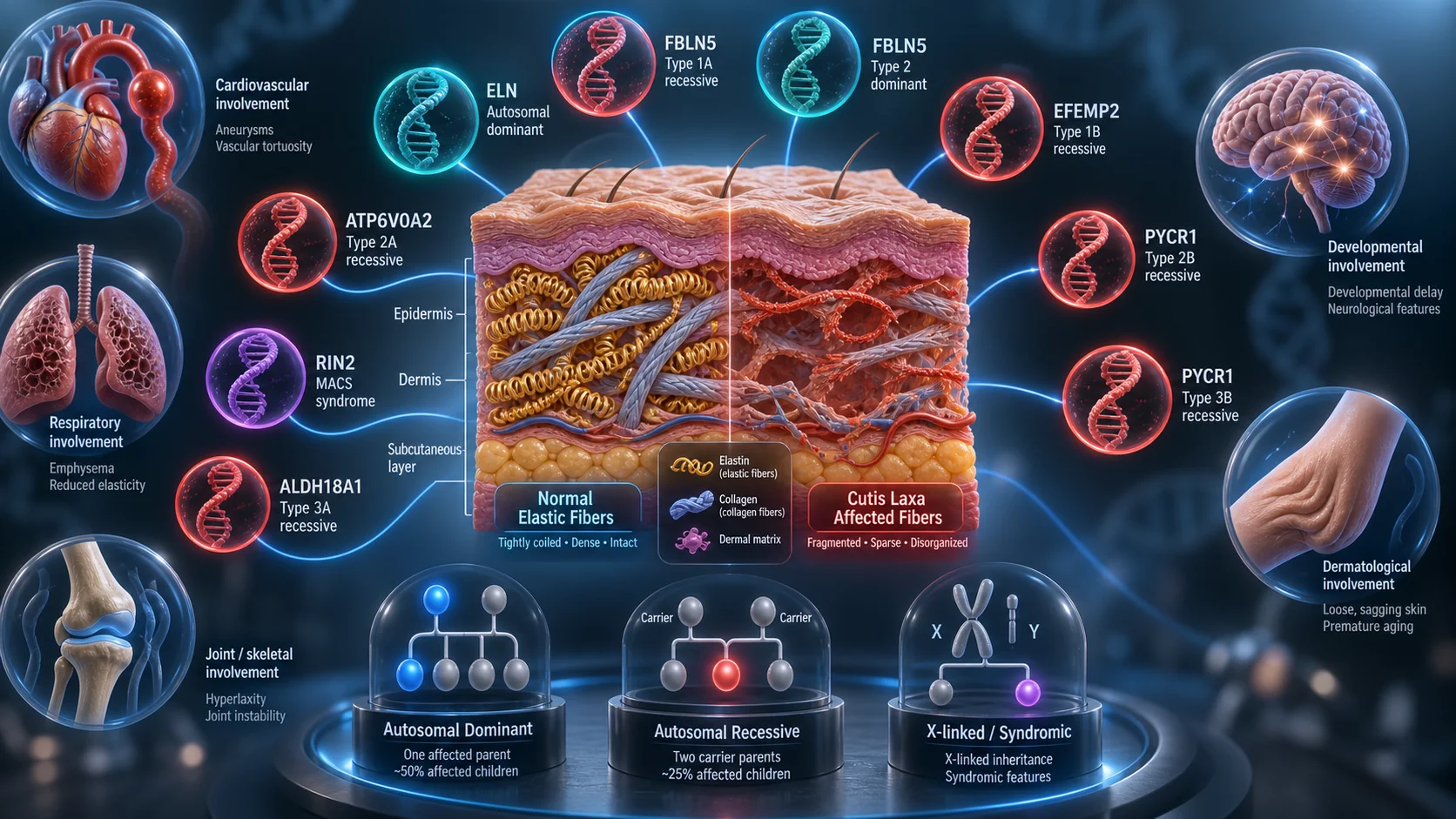
Cutis Laxa Explained: How Nine Different Genes Cause One Skin Disorder — and Why the Distinction Matters
Clinically reviewed for DNA Labs UAE | Last updated July 2026
Cutis Laxa is not one condition — it is a family of at least nine genetically distinct disorders that happen to share a single visible feature: loose, sagging, prematurely aged-looking skin. What differs enormously between them is what is happening underneath the skin. Some forms stay cosmetic. Others involve the aorta, the lungs, the joints, or brain development, and that difference is written entirely in a single gene. In the UAE, where consanguineous marriage rates remain clinically significant, the autosomal recessive forms of Cutis Laxa are encountered more often than global prevalence data would suggest. This article explains the biology behind each subtype and why identifying the exact gene — not just the diagnosis of "Cutis Laxa" — is the single most important step in managing it.
"Families are often relieved when a dermatologist tells them 'it's Cutis Laxa' — but that word alone tells us almost nothing about prognosis. One gene change can mean a child needs nothing more than reassurance. A different gene, and that same skin finding is the first visible sign of a connective tissue problem that also affects the aorta or the lungs. My role as a clinical geneticist is to make sure a family never has to guess which situation they are in."
Dr. Lina Osama Zaki Quteineh
Consultant Medical Genetics | DHA Registration ID: 9294403
What Is Actually Going Wrong Under the Skin?
Skin gets its elasticity from a scaffold of proteins in the dermis — primarily elastin fibers, which are cross-linked and organized into functional networks by a group of "helper" proteins called fibulins. When the gene coding for elastin, or one of these organizing fibulins, carries a disease-causing variant, the elastic fibers form incorrectly: they are fragmented, sparse, or clump abnormally. The skin loses its ability to recoil after stretching, which produces the hallmark appearance of Cutis Laxa — skin that hangs in loose folds, ages the face prematurely, and heals slowly.
Because elastin and its supporting proteins are not exclusive to skin — they are structural components of the aorta, lung alveoli, and ligaments — a mutation that disrupts them rarely stays confined to the skin. This is the biological reason why Cutis Laxa is classified by inheritance pattern and gene, not by appearance alone.
The Three Inheritance Patterns, and Why That Distinction Changes Everything
1. Autosomal Dominant Cutis Laxa (ADCL)
Caused by a single altered copy of a gene — meaning only one parent needs to carry the variant, and each child has a 50% chance of inheriting it. ADCL, most commonly linked to variants in ELN or FBLN5, tends to present later in life and is often milder, sometimes limited to skin laxity and mild emphysema risk in adulthood.
2. Autosomal Recessive Cutis Laxa (ARCL)
Requires both parents to carry a variant in the same gene — clinically silent carriers themselves. This is the category with the most subtypes (Type 1, Type 2, and Type 3), and the one where consanguinity meaningfully raises regional incidence. ARCL forms are typically more severe and present at birth or in early infancy, frequently with internal organ involvement — vascular fragility, respiratory complications, joint laxity, or developmental delay depending on the specific gene.
3. X-Linked and Syndromic Forms
A smaller group of Cutis Laxa-related syndromes follow X-linked or complex inheritance and combine skin findings with distinct syndromic features — for example, RIN2-related disease, which combines cutis laxa with macrocephaly, alopecia, and scoliosis.
Gene-by-Gene Breakdown: Nine Genes, Nine Clinical Pictures
The table below maps each gene our laboratory sequences to its associated Cutis Laxa subtype and the organ systems most relevant to monitor. This is the framework a clinical geneticist actually works from — not the skin finding alone.
| Gene | Subtype | Inheritance | Key Systems Involved |
|---|---|---|---|
| FBLN5 | Type 2, Dominant | Autosomal Dominant | Skin, lung elasticity |
| FBLN5 | Type 1A | Autosomal Recessive | Vasculature, lungs (severe) |
| ELN | Dominant Cutis Laxa | Autosomal Dominant | Skin, mild emphysema risk |
| EFEMP2 | Type 1B | Autosomal Recessive | Aorta, arterial tortuosity |
| ATP6V0A2 | Type 2A | Autosomal Recessive | Skin, skeletal, brain development |
| RIN2 | MACS Syndrome | Autosomal Recessive | Skin, hair, skeleton (scoliosis) |
| ALDH18A1 | Type 3A | Autosomal Recessive | Neurological, joints, growth |
| PYCR1 | Type 2B | Autosomal Recessive | Skin, skeletal, developmental delay |
| PYCR1 | Type 3B | Autosomal Recessive | Neurological, connective tissue |
Note: Two subtypes above (Type 2B and Type 3B) both trace back to the PYCR1 gene — a clear illustration of why gene-level sequencing, not clinical impression alone, is required to separate overlapping presentations.
Why This Matters More in the UAE Context
Autosomal recessive conditions cluster disproportionately in populations with higher rates of consanguineous marriage, which remains common across parts of the Gulf region. This does not mean recessive Cutis Laxa is common in absolute terms — it remains rare — but it does mean that when a UAE-based family has one affected child, the recurrence risk in future pregnancies (typically 25% for autosomal recessive forms) is a conversation worth having early, ideally supported by carrier information for both parents rather than the affected child alone.
How a Geneticist Actually Approaches Diagnosis
Skin biopsy and physical examination can support a clinical suspicion of Cutis Laxa, but they cannot reliably distinguish between subtypes — the fiber changes look similar under the microscope across several of these genes. The distinguishing step is molecular: targeted single-gene sequencing when a specific subtype is clinically suspected (for example, based on associated features like scoliosis pointing toward RIN2, or early vascular signs pointing toward EFEMP2), or a broader connective-tissue gene panel when the presentation is ambiguous.
For families who have already had one affected child, carrier testing of both parents for the identified familial variant is the most direct way to clarify recurrence risk before a subsequent pregnancy.
Key Takeaways
- "Cutis Laxa" describes an appearance, not a single diagnosis — at least nine genes and three inheritance patterns are involved.
- Autosomal recessive forms carry higher regional relevance in populations with elevated consanguinity rates.
- The same visible skin finding can range from a cosmetic issue to a marker of significant vascular or neurological involvement, depending entirely on the underlying gene.
- Gene-level sequencing — not skin biopsy alone — is what separates these subtypes and informs what else, if anything, needs monitoring.
This article is intended for general educational purposes and does not replace an individualized consultation. Families with a personal or family history of Cutis Laxa features should discuss targeted gene sequencing options with a qualified clinical geneticist.
Content clinically reviewed and approved for publication by Dr. Lina Osama Zaki Quteineh, Consultant Medical Genetics (DHA Registration ID: 9294403), under the clinical governance oversight of DNA Labs UAE.
Medically Reviewed by Dr. Dr. Ajay Singh
DHA Licensed in Clinical Medicine
All content on DNA Labs UAE is reviewed by qualified medical professionals to ensure accuracy and compliance with clinical guidelines.
⚕️ Medical Disclaimer
This article is for informational purposes only and does not constitute medical advice. Always consult with a qualified healthcare professional for diagnosis and treatment.
Found this helpful? Book a test or consult our team.