
Y Chromosome Microdeletion Test in UAE | AZF Testing
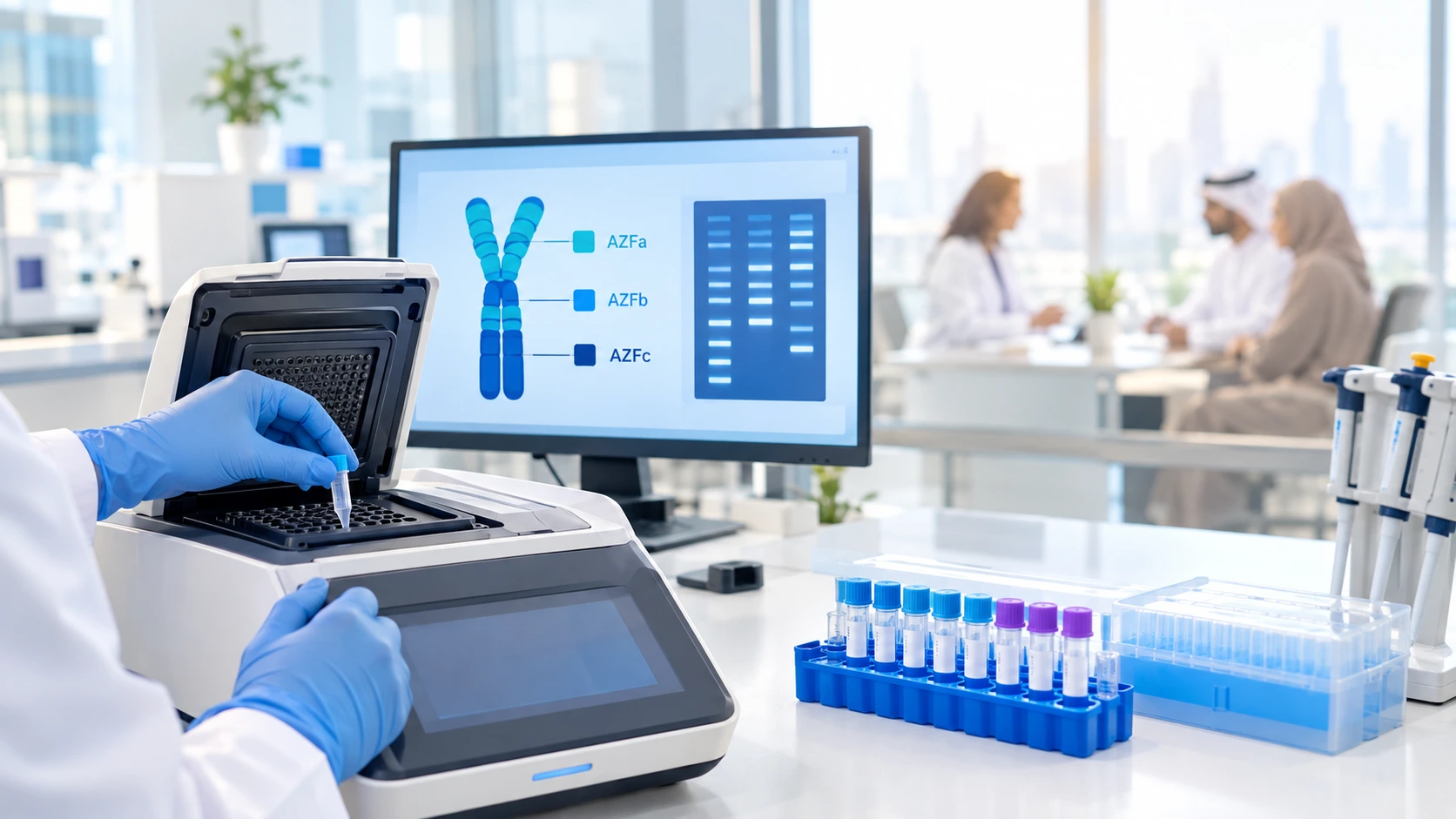
Y Chromosome Microdeletion Test in the UAE: What Male Infertility Investigations Often Miss
A consultant medical geneticist's clinical guide to AZF-region testing — why a normal semen analysis doesn't rule out a genetic cause of infertility, and what a microdeletion result means for a couple's next step, including for future sons.
Dr. Lina Osama Zaki Quteineh
Consultant Medical Genetics · DHA Registration ID: 9294403
Executive Summary: In my clinical work with male infertility cases across the UAE, Y chromosome microdeletion is one of the most under-tested genetic causes of severe oligospermia and azoospermia. It is not part of a routine semen analysis, yet it directly changes the counseling I give a couple before they pursue ICSI — particularly regarding whether a resulting son could inherit the same fertility challenge.
What the AZF Region Actually Controls
The Y chromosome carries a segment called the azoospermia factor (AZF) region, divided into three sub-regions — AZFa, AZFb, and AZFc — each holding genes essential for different stages of sperm production (spermatogenesis). A microdeletion is a small, often microscopic loss of genetic material within one of these sub-regions. Unlike a karyotype, which visualizes whole chromosome structure, this test uses PCR-based molecular analysis to detect these small, targeted deletions that a standard chromosome analysis would miss entirely.
Clinically, where the deletion occurs matters as much as whether one exists:
AZFa Deletion
The rarest but most severe. Typically associated with complete absence of sperm-producing cells (Sertoli cell-only syndrome), meaning surgical sperm retrieval is very unlikely to succeed.
AZFb Deletion
Associated with a maturation arrest of sperm cells. Sperm retrieval outcomes are generally poor, which meaningfully shapes whether surgical retrieval is even attempted.
AZFc Deletion
The most common deletion. Some men still produce limited sperm, so surgical retrieval combined with ICSI has a realistic, though not guaranteed, chance of success.
Why This Test Deserves More Attention in UAE Fertility Workups
A large share of infertility evaluation in the region still centers on the female partner first, even though male-factor infertility contributes to roughly half of all infertility cases globally. In my consultations, I regularly see men referred late — often only after multiple failed IVF or ICSI cycles — for genetic testing that could have shaped the treatment plan from the outset. Given the UAE's high reliance on assisted reproduction and the cultural weight placed on family continuity, identifying a Y-linked genetic cause early changes both the clinical roadmap and the conversation a couple has about realistic outcomes.
There is also a generational dimension unique to this test. Because the Y chromosome passes intact from father to son, a man who conceives via ICSI using surgically retrieved sperm will pass the same microdeletion to any son he has. This is not a discussion that belongs on a lab test order form — it belongs in a genetic counseling session before treatment begins.
When This Test Is Clinically Indicated
- 1 Severe oligospermia — sperm concentration below approximately 5 million/mL on semen analysis
- 2 Non-obstructive azoospermia — absence of sperm in the ejaculate not explained by a blockage
- 3 Prior to surgical sperm retrieval procedures (TESE/micro-TESE), to help set realistic expectations on retrieval success
- 4 Prior to ICSI, where a father's Y-linked deletion carries direct implications for a future son
- 5 Unexplained male infertility with otherwise normal hormonal and anatomical evaluation
Y Microdeletion Testing vs. Karyotype: Different Questions, Same Workup
Patients often assume a karyotype already covers this. It doesn't. A karyotype detects whole-chromosome structural or numerical abnormalities, such as Klinefelter syndrome (47,XXY) — a separate and more common cause of male infertility. A Y chromosome microdeletion, by contrast, is far too small to see on a karyotype and requires targeted molecular analysis of specific AZF markers. In a thorough male infertility workup, I typically recommend both tests together rather than one in place of the other, since they identify entirely different genetic mechanisms.
"The hardest conversations I have aren't about the deletion itself — they're about what it means for a future son. A man with an AZFc deletion can often still father a child through ICSI, but I make sure every couple understands that same deletion will very likely be inherited. That's not a footnote; it's a decision point that deserves its own dedicated counseling session, not a rushed mention before a procedure."
— Dr. Lina Osama Zaki Quteineh, Consultant Medical Genetics, DHA Registration ID: 9294403
What Happens After a Positive Result
A confirmed microdeletion moves the clinical conversation in one of a few directions, depending on which AZF region is involved: whether surgical sperm retrieval is realistically worth attempting, whether donor sperm should be discussed as an option, and — for couples proceeding with ICSI — how to counsel around the near-certain transmission of the deletion to a son. None of these are decisions a lab report makes on its own; they're worked through with a genetic counselor alongside the fertility specialist managing the couple's IVF or ICSI cycle.
Choosing the Right Panel Depth
Not every clinical picture requires the same level of molecular detail. A focused screen covering the core AZFa, AZFb, and AZFc markers is often sufficient for an initial infertility workup, while an expanded multi-marker panel can offer finer resolution on partial deletions or borderline cases. Which depth is appropriate is a decision best made with your treating physician based on your semen analysis and hormonal profile.
Explore the Clinical Test Pages
Frequently Asked Clinical Questions
Does a normal semen analysis rule out a Y microdeletion?
No. Microdeletion testing is typically reserved for men with significantly low or absent sperm counts; it is not part of a standard semen analysis and is ordered separately based on those findings.
Will a Y chromosome microdeletion affect a man's general health?
Generally no. These deletions are specific to genes involved in sperm production and are not typically associated with other health conditions outside of fertility.
If a father has a Y microdeletion, will every son inherit it?
If conception occurs via ICSI using the father's sperm, any resulting son will inherit the same Y chromosome, including the microdeletion, since the Y chromosome passes down largely unchanged from father to son.
This article is provided for patient education by DNA Labs UAE and reflects general clinical practice in reproductive genetics. It is not a substitute for individualized medical advice. Clinical content authored and reviewed by Dr. Lina Osama Zaki Quteineh, Consultant Medical Genetics, DHA Registration ID: 9294403, under the corporate clinical governance of DNA Labs UAE.
Medically Reviewed by Dr. Lina Osama Zaki Quteineh
DHA Licensed in Clinical Medicine
All content on DNA Labs UAE is reviewed by qualified medical professionals to ensure accuracy and compliance with clinical guidelines.
⚕️ Medical Disclaimer
This article is for informational purposes only and does not constitute medical advice. Always consult with a qualified healthcare professional for diagnosis and treatment.
Found this helpful? Book a test or consult our team.