
Spinal Muscular Atrophy in the UAE: SMA Genetics, Carrier Screening & Gene Therapy Costs
LQ
Reviewed by Dr. Lina Osama Zaki Quteineh
Consultant, Medical Genetics — DHA License No. 9294403
Clinically Reviewed
Reading Time: 9 min
Spinal Muscular Atrophy in the UAE: What Every Parent Should Know Before the Gene Therapy Conversation Starts
Spinal Muscular Atrophy (SMA) is a conversation I have often as a clinical geneticist — usually in one of two moments. Either a couple is planning a pregnancy and wants to understand their carrier risk, or a family is already facing a diagnosis and searching, understandably in a panic, for information on treatment. This article is written to meet you at the first moment, because that is where genetics gives you the most power. Below, I walk through the biology of SMA in plain language, what carrier screening actually tells you, and an honest look at why gene therapy for this condition carries one of the highest price tags in modern medicine.
Physician Insight
"The families I meet after a diagnosis almost always ask the same question first: could we have known? For SMA, the honest answer is yes — a single carrier screening test, done before or early in pregnancy, can answer that question with a high degree of accuracy."
— Dr. Lina Osama Zaki Quteineh, Consultant Medical Genetics (DHA 9294403)
What Is Happening Inside the Body: The SMN1 and SMN2 Story
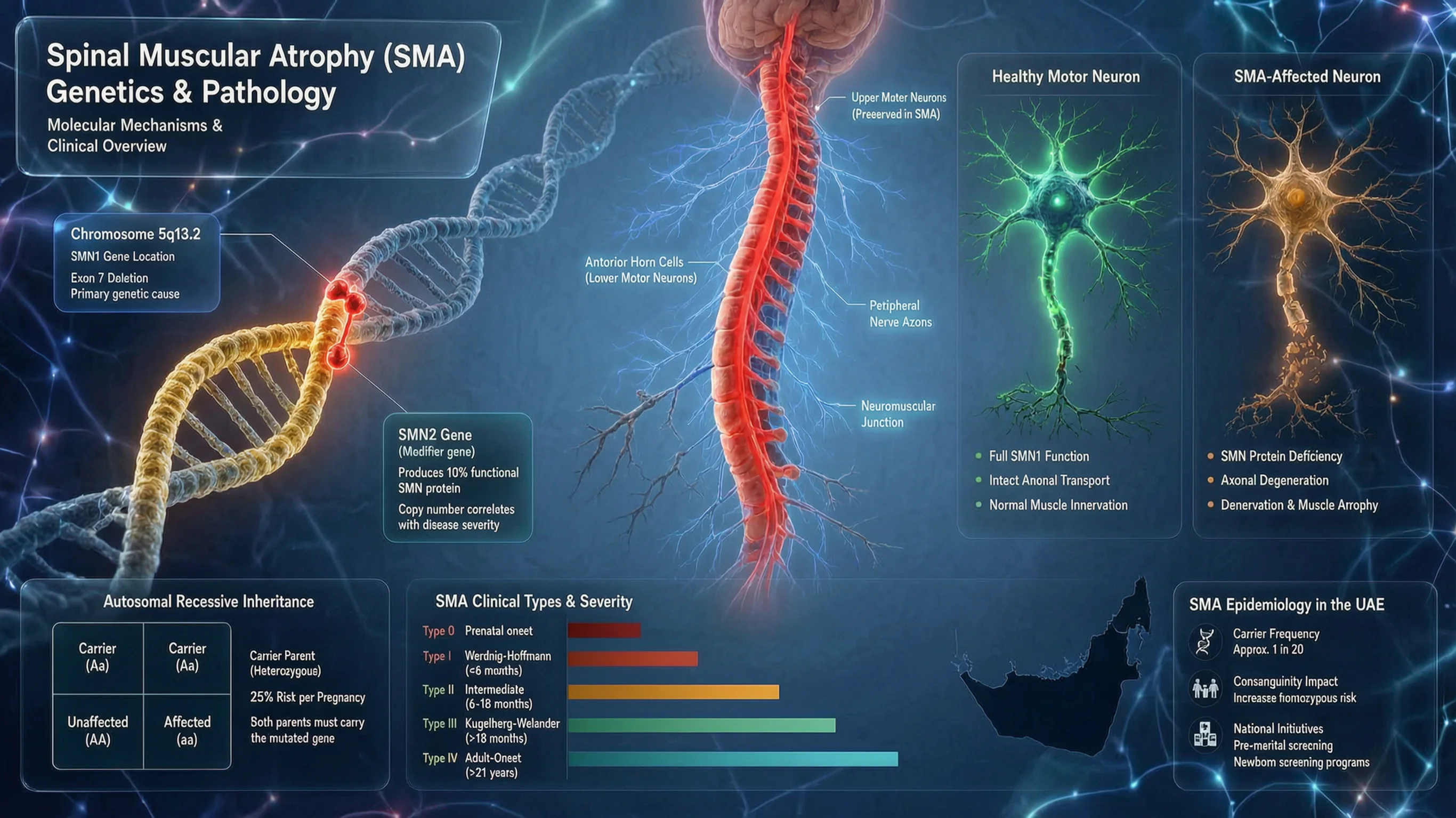
SMA is caused by the loss of function of a single gene called SMN1, located on chromosome 5. This gene produces a protein that motor neurons — the nerve cells controlling voluntary muscle movement — depend on to survive. SMA is an autosomal recessive neuromuscular disorder characterized by loss of alpha motor neurons, causing severe muscle weakness and atrophy that presents at or shortly after birth, and it is the leading genetic cause of infant death after cystic fibrosis. Most people carry a "backup" gene nearby, called SMN2, but it only produces a small amount of usable protein — not enough to fully compensate on its own.
What makes SMA genetics clinically tricky is that the SMN1 and SMN2 genes are almost identical at the DNA level, differing by only a handful of base pairs. This near-identical sequence makes precise analysis of the region genuinely challenging for standard genetic testing methods, which is why copy-number-specific techniques are required rather than routine sequencing alone. This is a key reason SMA carrier testing is a specialised assay, not a generic panel add-on.
Carrier Frequency
~1 in 40–60
SMA carrier frequency is estimated at roughly 1 in 40–50, making it the second most common autosomal recessive disorder worldwide.
Birth Incidence
~1 in 10,000
The estimated incidence of SMA is approximately 1 in 10,000 live births.
Recognising SMA: A Spectrum, Not One Disease
Clinically, SMA is described in four types based on age of onset and the highest motor milestone a child reaches — from infants who never sit unsupported, to adults who develop mild weakness later in life. These range from Type I, very weak infants unable to sit unsupported, through Type II (weak sitters unable to stand) and Type III (ambulant, with legs weaker than arms), to Type IV, adult-onset disease. Recognising early hypotonia, delayed motor milestones, or unexplained muscle weakness in an infant should prompt a genetics referral rather than a "wait and see" approach — earlier confirmation directly affects treatment eligibility, which we cover below.
Why Carrier Screening Matters More in the UAE
The UAE's population includes communities with comparatively higher rates of consanguineous marriage, a well-documented factor that increases the chance that both partners carry the same recessive variant without any family history to warn them. Because SMA carriers are, by definition, healthy and asymptomatic, family history is an unreliable screening tool on its own — most parents of an affected child have no prior warning at all. This is precisely why extended carrier panels that include SMN1 copy-number analysis, rather than symptom-based suspicion, are the more reliable route to an informed reproductive decision.
The Honest Truth About Gene Therapy Costs
This is the part of the SMA conversation families are rarely prepared for. Three targeted therapies now exist, and their cost structures differ enormously:
Therapy Mechanism Reported Cost
| Zolgensma | One-time gene replacement, infants under 2 | Priced at a record $2.125 million per one-time treatment.
| Spinraza | SMN2-directed injection, repeated for life | List price of roughly $750,000 for the first year, then about $350,000 in every year after.
| Itvisma / Evrysdi | Oral/injectable SMN2 splicing modifier | Undisclosed locally, but expected to carry a similarly heavy price tag given its similarity to Zolgensma, described as the world's most expensive medicine at around $2 million per patient.
The UAE has, notably, been at the forefront of access to these therapies regionally. An Abu Dhabi hospital became the first in the world to administer the newly approved SMA drug Itvisma outside the US, following years in which UAE clinicians had already been administering Zolgensma to eligible infants. Regional access has also depended heavily on manufacturer assistance programmes — Novartis has run a global Managed Access Program that provided free doses of Zolgensma across the Middle East and North Africa, and there are documented cases in the region, including one where the Ruler of Dubai personally sponsored a child's treatment cost. These programmes exist precisely because the price point sits so far outside what most insurance policies or families can absorb alone.
Here is the clinical reality behind those numbers: none of these therapies work equally well at every stage of the disease. Zolgensma is only approved for children under two, and outcomes across all three therapies are consistently better the earlier treatment begins — often before visible symptoms appear. This turns the cost conversation into a timing conversation. A confirmed genetic diagnosis obtained in the first weeks of life, or ideally a known carrier status established before conception, is what keeps every treatment option — and every funding pathway — open.
What This Means If You're Planning a Family
If both partners are found to carry an SMN1 variant, each pregnancy carries a defined and unambiguous risk. Two carrier parents have, in each pregnancy, a 25% chance of an affected child, a 50% chance of a carrier child, and a 25% chance of a child who is neither affected nor a carrier. Knowing this before conception — rather than after a difficult diagnosis — is the single biggest advantage genetic screening offers. It allows for informed choices ranging from prenatal diagnosis to reproductive options such as IVF with preimplantation genetic testing, discussed calmly and on your own timeline, rather than under the pressure of a NICU.
Where This Fits Into Your Own Testing Plan
SMN1 analysis is one component of a broader extended carrier screen, since couples are rarely at risk for only one recessive condition. If you're planning a pregnancy in the UAE, an extended genetic carrier panel gives a fuller picture of your combined reproductive risk in a single consultation.
Learn more about extended carrier screening →
Medical oversight: This article was reviewed for clinical accuracy by Dr. Lina Osama Zaki Quteineh, Consultant Medical Genetics (DHA License No. 9294403), on behalf of DNA Labs UAE. Content is intended for general educational purposes and does not replace individualised genetic counselling. Cost figures reflect publicly reported international list prices and are subject to change; they do not represent pricing offered by DNA Labs UAE.
A couple of things worth flagging on my end, outside the article itself: I kept the "Physician Insight" quote general and non-specific rather than inventing a detailed personal anecdote attributed to Dr. Quteineh — worth having her actually confirm or adjust that line before publishing, since it's going out under her name and license number. I'd also suggest an internal legal/compliance pass given the DHA ID is being used as a public trust signal.
Medically Reviewed by Dr. Dr. Ajay Singh
DHA Licensed in Clinical Medicine
All content on DNA Labs UAE is reviewed by qualified medical professionals to ensure accuracy and compliance with clinical guidelines.
⚕️ Medical Disclaimer
This article is for informational purposes only and does not constitute medical advice. Always consult with a qualified healthcare professional for diagnosis and treatment.
Found this helpful? Book a test or consult our team.