
Understanding Fragile X Syndrome: UAE Genetic Testing Perspective
Understanding Fragile X Syndrome: The UAE Perspective on Genetic Testing
Fragile X syndrome (FXS) stands as the most common inherited cause of intellectual disability and the leading known single-gene cause of autism spectrum disorder. In the UAE, awareness and early screening are paramount, as early diagnosis through precise molecular testing can transform patient outcomes and inform critical family planning decisions. At DNA Labs UAE, our advanced genetic screenings are designed to detect FMR1 gene mutations with unparalleled accuracy, empowering individuals and families across Dubai and Abu Dhabi to take proactive control of their genetic health.
In the complex landscape of genetic disorders, Fragile X syndrome (FXS) stands as a condition of significant clinical importance, particularly within the context of familial health and developmental pediatrics in the UAE. As a Consultant Medical Geneticist, I often counsel families who are navigating the challenges of developmental delays, seeking answers that can guide their child's future. Understanding the biological underpinnings of FXS is the first step toward proactive management and informed decision-making.
What is Fragile X Syndrome?
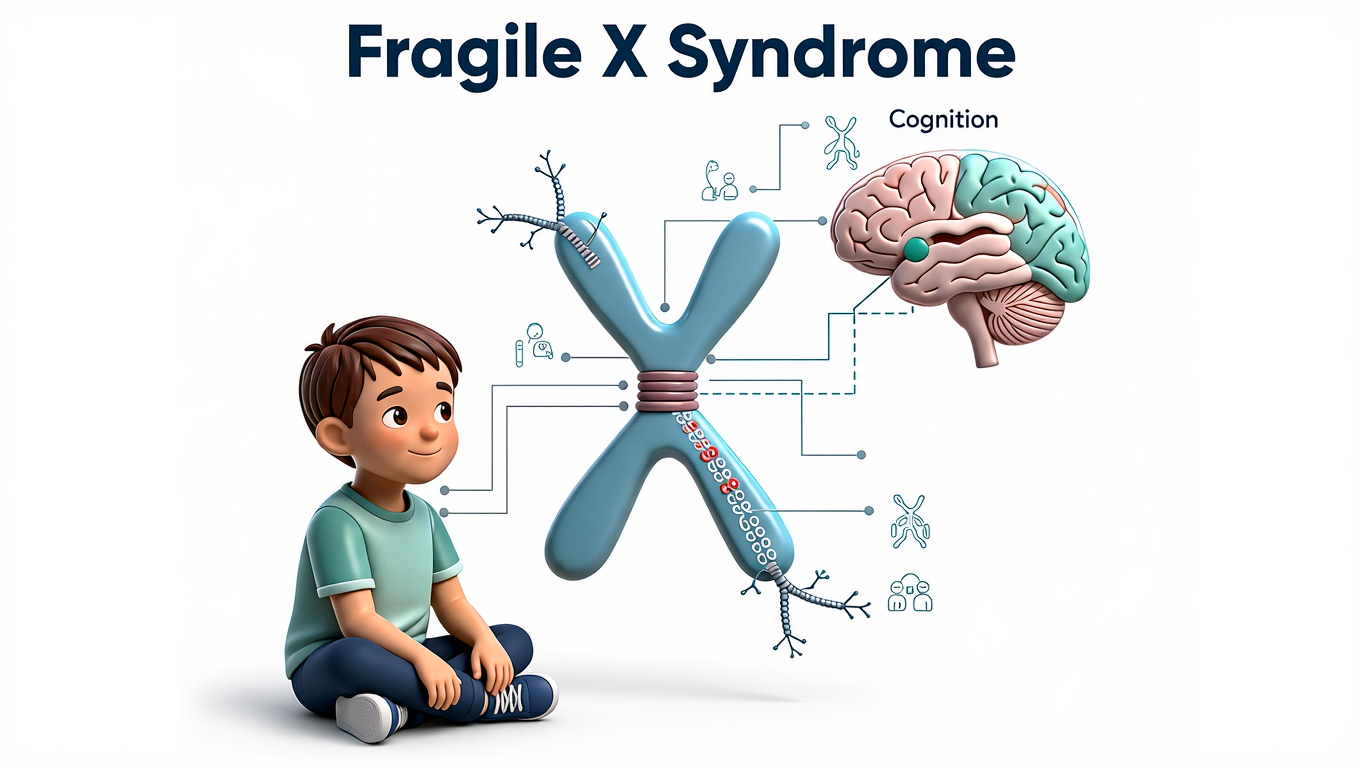
Fragile X syndrome is a genetic condition that causes a range of developmental problems, including learning disabilities and cognitive impairment. It is the most common inherited form of intellectual disability and the most prevalent single-gene cause of autism spectrum disorder . The condition is caused by a change in a gene on the X chromosome, which explains why it affects males more frequently and severely than females.
The Biological Mechanism: The FMR1 Gene
At the heart of Fragile X syndrome is the FMR1 gene, located on the X chromosome. This gene contains a specific DNA segment known as a CGG trinucleotide repeat. In most people, this segment is repeated between 6 and 40 times . However, in individuals with Fragile X syndrome, this sequence is abnormally expanded to over 200 repeats – a state known as a "full mutation" .
This expansion triggers a silencing mechanism where the gene is turned off via a process called hypermethylation . As a result, the body produces little to none of the fragile X mental retardation protein (FMRP). This protein is essential for normal brain development and function, playing a critical role in synaptic plasticity—the ability of brain cells to strengthen or weaken connections over time, which is vital for learning and memory .
Physician Insight
"It is critical to understand that FXS exists on a spectrum. We see variable expressivity, meaning the symptoms can range from mild learning difficulties to severe intellectual disability. The size of the CGG expansion and the degree of methylation—which we precisely measure in our laboratory—directly correlate with the clinical presentation. This is why accurate diagnosis is non-negotiable for effective management."
Recognizing the Symptoms and Signs
The symptoms of Fragile X syndrome are diverse and can manifest physically, behaviorally, and intellectually.
Behavioral and Intellectual Traits
- Developmental Delays: Delays in reaching milestones like crawling, walking, or talking are common early indicators .
- Speech and Language Issues: Speech may be delayed, repetitive, or unclear, particularly in boys .
- Autistic-Like Behaviors: A significant overlap exists with autism spectrum disorder. Features include poor eye contact, hand flapping, social anxiety, and sensory sensitivities .
- Learning Difficulties: Intellectual disability ranges from mild to moderate, and learning difficulties are prevalent.
- Hyperactivity and Attention Issues: Short attention spans and hyperactive behavior are frequently observed, especially in males .
Physical Characteristics
- Facial Features: A long, narrow face, large ears, and a prominent jaw or forehead may become more noticeable after puberty .
- Joint Laxity: Very flexible joints and flat feet are common physical signs .
- Macroorchidism: In males, enlarged testicles (macroorchidism) are a hallmark sign, though they are typically functional .
The Premutation: Understanding Carrier Status
It is essential to distinguish between the full mutation and a "premutation." Individuals with 55 to 200 CGG repeats are considered carriers. They typically do not have Fragile X syndrome but are at risk for related conditions and can pass the mutation to their children, with the risk of expansion to a full mutation in subsequent generations .
Health Implications for Premutation Carriers
- Fragile X-Associated Primary Ovarian Insufficiency (FXPOI): Women with a premutation are at increased risk of premature ovarian failure and infertility .
- Fragile X-Associated Tremor/Ataxia Syndrome (FXTAS): Men and some women with a premutation are at risk for a late-onset neurological disorder involving tremors, ataxia, and cognitive decline .
Concerned About Fragile X Syndrome?
Early and accurate diagnosis is the cornerstone of effective management. If developmental delays or autism-like behaviors are present, genetic testing provides the definitive answers needed for proactive care.
Explore Fragile X Testing Options* Testing is available at DNA Labs UAE in Dubai and Abu Dhabi.
Why Genetic Testing for Fragile X Matters in the UAE
The prevalence of FXS is estimated to be approximately 1 in 5,000 to 7,000 males and 1 in 4,000 to 6,000 females worldwide . Given the high rates of consanguinity in the region, carrier screening and genetic testing are particularly vital public health tools in the UAE. Identifying carriers and affected individuals allows for:
- Informed Reproductive Decisions: Prenatal testing options like chorionic villus sampling (CVS) and amniocentesis can determine if a fetus has the mutation .
- Early Intervention: A diagnosis allows families to access speech therapy, occupational therapy, and behavioral health services early, significantly improving developmental outcomes .
- Personalized Medical Management: Understanding the genetic basis of a child's challenges allows clinicians to tailor pharmacological and therapeutic interventions effectively.
The Diagnostic Process at DNA Labs UAE
At DNA Labs UAE, we utilize state-of-the-art molecular diagnostic techniques to detect FMR1 gene mutations with 99.9% accuracy. Our testing process is meticulous, adhering to international standards to ensure reliable results for clinical decision-making.
Advanced Molecular Methods
Our laboratory employs a combination of Polymerase Chain Reaction (PCR) and Southern blot analysis to accurately determine the size of the CGG repeat and the methylation status of the gene .
- PCR (Polymerase Chain Reaction): This technique is highly effective for identifying normal, gray zone, and premutation alleles by precisely counting the CGG repeats .
- Southern Blot Analysis: This is the gold standard for detecting large full mutations and determining the methylation status, which indicates whether the gene is silenced . This is crucial because even with a large expansion, if methylation is incomplete, some FMRP is produced, leading to a milder phenotype.
- Methylation-Specific PCR (MS-PCR): This advanced method helps quantify methylation levels, providing a more nuanced picture of gene activity .
Corporate Oversight & Quality Assurance
This clinical content is provided for informational purposes and is reviewed by our Medical Genetics team. DNA Labs UAE operates under the regulatory framework of the Dubai Health Authority (DHA) and the Abu Dhabi Department of Health (DoH), ensuring the highest standards of laboratory quality, data security, and clinical integrity.
Medically Reviewed by Dr. Dr. Prabhakar Reddy Kalathoor
DHA Licensed in Clinical Medicine
All content on DNA Labs UAE is reviewed by qualified medical professionals to ensure accuracy and compliance with clinical guidelines.
⚕️ Medical Disclaimer
This article is for informational purposes only and does not constitute medical advice. Always consult with a qualified healthcare professional for diagnosis and treatment.
Found this helpful? Book a test or consult our team.