
DMD Gene - Duchenne Muscular Dystrophy Genetic Test in UAE
Understanding Duchenne Muscular Dystrophy: The Critical Role of Carrier Screening in the UAE
Physician Insight
"As a DHA-licensed General Practitioner, I emphasize that DMD carrier screening, while highly accurate, must be interpreted within the full context of a detailed family history, clinical examination, and biochemical markers like creatine kinase levels. A negative screening result does not eliminate the possibility of a rare or novel mutation, and clinical correlation remains paramount. Genetic counseling is an integral part of this process, ensuring that individuals fully understand the implications of their results before making irreversible family planning decisions."
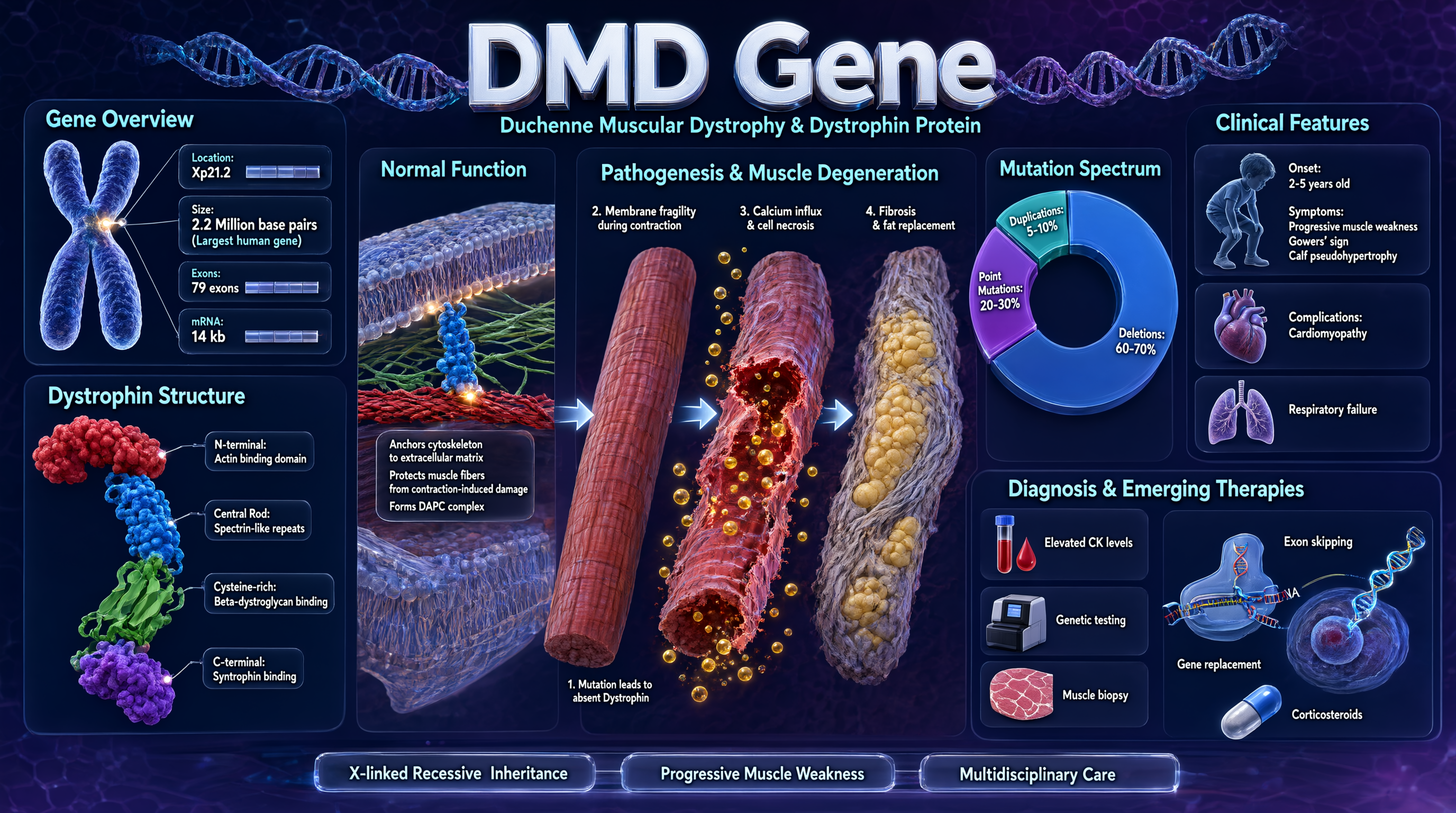
When we discuss Duchenne Muscular Dystrophy (DMD) Carrier Screening in the UAE, we are addressing one of the most severe yet preventable genetic disorders affecting children. DMD is a devastating X-linked recessive condition caused by mutations in the DMD gene—the largest known human gene—leading to progressive muscle degeneration and loss of function. While the condition predominantly affects males, the clinical application of comprehensive carrier screening in the UAE carries a unique weight, shaped by our population's genetic landscape and family structures.
The biology is precise: mutations in the DMD gene prevent production of functional dystrophin, the protein that acts as a shock absorber for muscle fibers. Without it, muscle cells are gradually replaced by fat and fibrotic tissue. But the clinical reality in our region demands a deeper understanding—one that moves beyond textbook genetics to the practical implications of carrier identification, reproductive decision-making, and early intervention.
Live male births affected by DMD globally
Risk of a carrier mother passing the mutation to each son
Comprehensive screening coverage with MLPA technology
The Biology of DMD: Why Comprehensive Testing Matters
The DMD gene contains 79 exons that provide the blueprint for the dystrophin protein. Mutations can take several forms, each requiring specific detection methods. Understanding this molecular complexity is critical because the type and location of a mutation directly determines disease severity.
Deletions of one or more exons account for approximately 60–70% of DMD cases. Duplications represent another 5–10%, while point mutations and small insertions or deletions make up the remaining pathogenic variants. Critically, in Duchenne Muscular Dystrophy, mutations disrupt the reading frame of the gene, preventing any functional dystrophin production. By contrast, in the milder Becker Muscular Dystrophy (BMD), the reading frame is maintained, allowing production of a partially functional protein.
"The specific type and location of a mutation in the DMD gene determines whether a person has DMD or the milder BMD. This is why targeted or limited genetic tests that only scan select exons can miss critical pathogenic variants. Comprehensive testing of all 79 exons is not optional—it is essential."
X-Linked Inheritance: The Silent Carrier Phenomenon
Duchenne Muscular Dystrophy follows an X-linked recessive inheritance pattern, which is the cornerstone of understanding why the disease affects males almost exclusively and why carrier screening for females is the primary intervention point.
Males possess one X chromosome (from their mother) and one Y chromosome (from their father). If a boy inherits a mutated DMD gene on his single X chromosome, he will develop the disease because there is no backup copy. Females have two X chromosomes—one from each parent. When a female inherits a mutated DMD gene, her second healthy X chromosome typically produces sufficient dystrophin to prevent symptoms. She becomes a silent carrier, often unaware of her status until an affected son is born.
The inheritance risk is stark: each son of a carrier mother has a 50% chance of inheriting the affected X chromosome and developing DMD. Each daughter has a 50% chance of being a carrier herself. This pattern means that DMD can remain hidden across generations of female carriers before manifesting in a male child, making comprehensive family screening essential once a carrier is identified.
Who Should Consider DMD Carrier Screening in the UAE
Clinical guidelines recommend DMD carrier screening for women who meet any of the following criteria, reflecting both global best practices and the specific genetic considerations of the UAE population:
- Known Family History: Women with a confirmed family history of Duchenne or Becker muscular dystrophy in male relatives—sons, brothers, nephews, or maternal uncles.
- Unexplained Elevated Creatine Kinase (CK) Levels: Elevated CK in blood tests can indicate ongoing muscle damage and may be a subclinical sign of carrier status in otherwise asymptomatic females.
- Planning a Family: Any woman who is planning to conceive and wishes to understand her risk of passing on a genetic condition, particularly relevant in populations with known founder mutations or higher consanguinity rates.
- Confirmed Diagnosis in a Close Relative: If a male relative has been diagnosed with DMD, all at-risk female relatives should be offered carrier testing to map the genetic risk across the family tree.
The Gold Standard: 79-Exon MLPA with NGS Reflex Testing
In the UAE, advanced genetic laboratories employ a two-tiered testing strategy that represents the most comprehensive approach to DMD carrier screening available.
Primary Analysis: MLPA
- Technology: Multiplex Ligation-dependent Probe Amplification
- Coverage: All 79 exons of the DMD gene
- Detection: Large deletions and duplications (70–80% of pathogenic variants)
- Sensitivity: Over 99% for targeted mutation types
Reflex Testing: NGS
- Technology: Next-Generation Sequencing
- Coverage: Full gene sequencing
- Detection: Point mutations, small insertions/deletions, splice-site variants
- Application: Automatically performed when MLPA is negative
This combined approach achieves over 99% analytical sensitivity for all types of DMD mutations, providing a definitive assessment of carrier status. Standard PCR-based methods, by contrast, may miss up to 70% of dystrophin mutations due to their limited scope. The MLPA-NGS reflex protocol ensures that if one technology yields a negative result, the second automatically investigates further, leaving no exon unexamined.
Managing Carrier Status: A Clinical Pathway
Identifying a DMD carrier is not an endpoint—it is the beginning of a proactive clinical and reproductive journey. A confirmed carrier result opens several evidence-based pathways:
Reproductive Planning
- Prenatal Diagnosis: Chorionic villus sampling (CVS) or amniocentesis to test the fetus during pregnancy.
- Preimplantation Genetic Diagnosis (PGD): IVF with embryo testing to select embryos without the DMD mutation prior to implantation.
- Gamete Donation: Use of donor eggs as an alternative reproductive option.
Family Cascade Screening
- At-Risk Female Relatives: Sisters, daughters, maternal aunts, and female cousins should be offered testing.
- Newborn Males: Male children of carriers can be tested at birth for early diagnosis.
- Early Intervention: Early diagnosis enables timely multidisciplinary care, including cardiac and respiratory monitoring, physical therapy, and corticosteroid treatment.
Clinical Correlation: The Role of Creatine Kinase and Family History
Genetic testing does not exist in isolation. Creatine kinase (CK) levels serve as a critical biochemical marker that can support carrier identification. Elevated CK in an asymptomatic female with a family history of DMD strongly suggests carrier status, even before genetic testing is performed. Conversely, a negative genetic test in the presence of persistently elevated CK and strong clinical suspicion may warrant further investigation for rare or deep intronic mutations not captured by standard assays.
This is why genetic counseling remains an integral, non-negotiable component of the carrier screening process. Results must be interpreted within the full clinical context—family pedigree analysis, biochemical markers, and physical examination findings—to provide accurate, actionable guidance.
The UAE Regulatory Framework: Data Privacy and Genetic Testing
Genetic testing in the UAE is governed by a robust regulatory framework designed to protect patient privacy and ensure clinical validity:
- Federal Decree-Law No. 45 of 2021 (PDPL): Ensures that all personal and genetic data is processed, stored, and shared with the highest levels of security and confidentiality.
- Federal Law No. 2 of 2019: Governs the use of health data and electronic medical records, ensuring genetic information is handled responsibly and ethically.
- National Neonatal Screening Program: While DMD is not currently on the standard newborn screening panel, the infrastructure for early detection of genetic disorders is a key pillar of the UAE's healthcare strategy, reflecting the country's commitment to precision prevention.
The Path Forward: Empowering Informed Family Planning
Duchenne Muscular Dystrophy is a devastating diagnosis, but it is also one that can be anticipated and planned for through comprehensive carrier screening. In the UAE, where advanced genomic technologies are increasingly accessible and regulatory frameworks ensure data protection, carrier screening represents a responsible, proactive step for families with a history of neuromuscular conditions.
The goal is not merely to identify risk, but to empower individuals with the knowledge they need to make informed reproductive decisions—whether that means prenatal diagnosis, preimplantation genetic testing, or early neonatal monitoring and intervention. Understanding your carrier status transforms uncertainty into a clinically guided, actionable plan.
If you have a family history of Duchenne or Becker muscular dystrophy, unexplained elevated creatine kinase levels, or are planning a family and wish to understand your genetic risk profile, comprehensive DMD Carrier Screening (79 Exons) provides the foundational data you need.
Medically Reviewed by Dr. Dr. Prabhakar Reddy Kalathoor
DHA Licensed in Clinical Medicine
All content on DNA Labs UAE is reviewed by qualified medical professionals to ensure accuracy and compliance with clinical guidelines.
⚕️ Medical Disclaimer
This article is for informational purposes only and does not constitute medical advice. Always consult with a qualified healthcare professional for diagnosis and treatment.
Found this helpful? Book a test or consult our team.