
Comprehensive Hereditary Cancer Panel (190 Genes) Test in UAE
Beyond BRCA: Why a 190-Gene Hereditary Cancer Panel Matters for the UAE Population
For decades, discussions about hereditary cancer risk have centered on a few well-known genes like BRCA1 and BRCA2. While these genes are critical, they represent only a fraction of the known hereditary cancer syndromes. The reality is more complex, particularly for populations like those in the UAE, where genetic diversity and specific cultural factors play a significant role.
Genetic testing has evolved from a targeted search to a comprehensive analysis, enabling the detection of risks across a much wider spectrum. For patients in the UAE, understanding this advanced testing landscape is crucial for personalized, proactive health management.
🧬 Physician Insight
"While mutations in genes like BRCA1 and BRCA2 are widely known, they do not account for the majority of hereditary cancer cases globally, and studies indicate their prevalence may differ significantly in Arab populations. A broader, multi-gene panel approach is essential for capturing the full spectrum of inherited cancer risk, especially in populations where the genetic architecture may be unique."
— Ajay Singh, General Practitioner, DHA Registration ID: 36234132
Understanding the UAE's Unique Genetic Landscape
Recent research has begun to illuminate the distinct genetic factors contributing to cancer in the UAE. A nationwide study using data from the Emirati Genome Program revealed that only 5.2% of breast cancer cases among Emirati women could be attributed to pathogenic variants in standard high-risk genes . This suggests that many hereditary cancer risks may stem from a wider array of genes or variants that are more prevalent in this population.
Several factors contribute to this unique landscape:
- High Consanguinity Rates: Consanguineous marriages, which are common in the region, can lead to an increased expression of homozygous recessive mutations, potentially amplifying cancer risk in ways not fully captured by traditional gene panels .
- Understudied Genetic Variants: Many well-known cancer predisposition markers were identified in European populations and may not be as relevant or prevalent in Arab populations. This underscores the need for ancestry-specific genetic research and broader testing panels .
- Genetic Architecture: The genetic architecture of cancers like breast cancer in the UAE is being defined, with studies showing that monogenic factors explain only a small fraction of the total disease burden, highlighting the importance of polygenic risk and other genetic interactions .
The Limitations of Narrow Testing
Historically, genetic testing often focused on single genes or small, syndrome-specific panels. While useful, this approach has significant limitations:
- Missed Diagnoses: Patients with variants in less common but equally important genes like PALB2, CHEK2, or ATM would be missed, leaving them without crucial risk information .
- Cumulative Cost and Time: Testing genes one by one is time-consuming and expensive, making comprehensive risk assessment impractical for many patients.
- Incomplete Risk Profile: A negative result on a small panel can provide false reassurance, as it does not eliminate the possibility of a hereditary syndrome caused by a gene not on that panel.
The Power of the 190-Gene Panel: A Comprehensive Approach
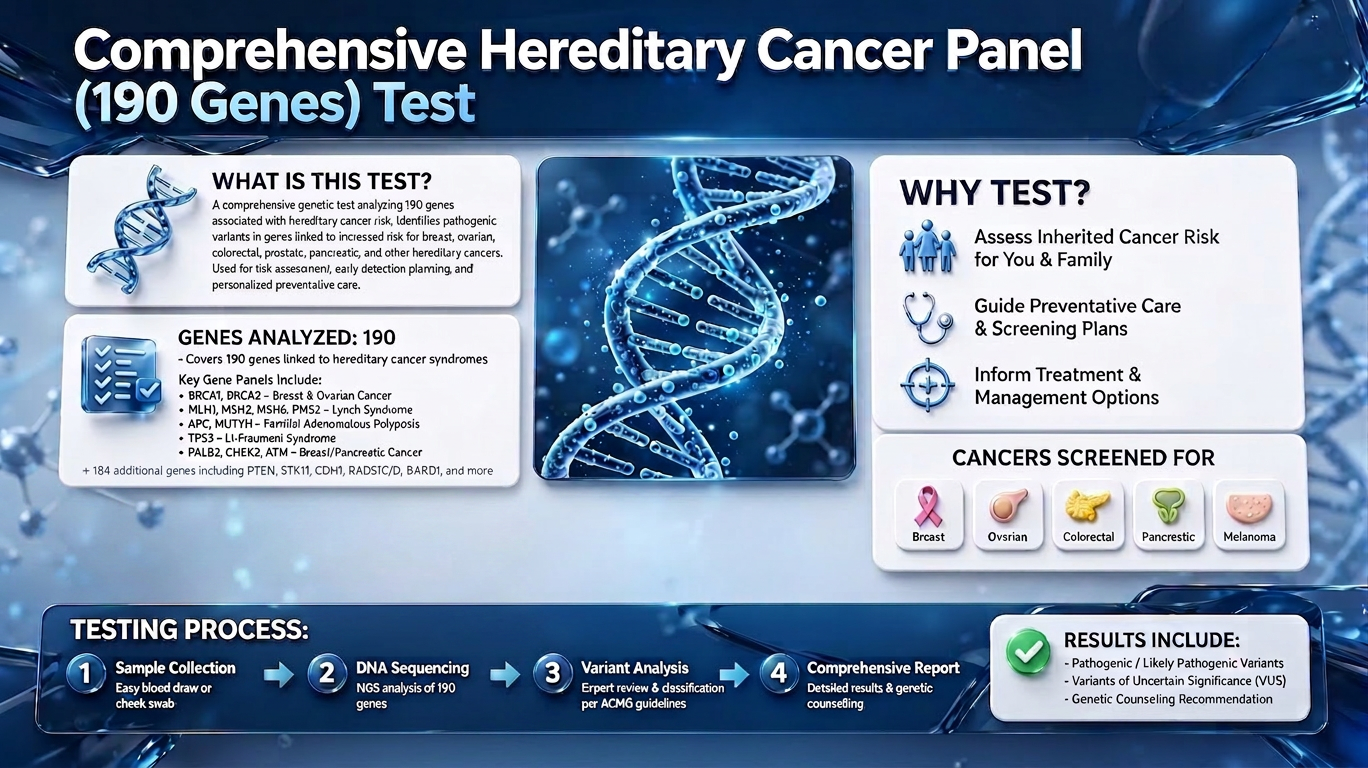
A comprehensive hereditary cancer panel that analyzes 190 genes simultaneously addresses these limitations by offering a complete, efficient, and cost-effective risk assessment. This approach aligns with the capabilities of modern Next-Generation Sequencing (NGS) technology, which allows for the high-throughput analysis of multiple genes at once with high analytical sensitivity and specificity.
This comprehensive approach means that a single test can evaluate genes associated with a broad spectrum of cancer types, from breast, ovarian, and colorectal to pancreatic, prostate, and many others . It is a vital tool for actionable risk stratification, enabling personalized surveillance and prevention strategies based on a complete genetic profile.
✅ Actionable Insight for UAE Patients
For individuals with a family history of cancer or those from high-risk backgrounds, a 190-gene panel can identify risks that standard testing might miss, allowing for earlier and more targeted screening, such as earlier mammograms or colonoscopies.
What to Expect from Your Results: Understanding Variant Classifications
Genetic test results are interpreted based on established guidelines. Variants are typically classified into categories that help guide clinical management:
- Pathogenic/Likely Pathogenic (P/LP): These variants are known to increase the risk of cancer. They are considered actionable and will form the basis for a personalized screening and management plan .
- Variants of Uncertain Significance (VUS): These are genetic changes where the clinical impact is not yet known. A VUS result is not a positive or negative finding, but rather an area of ongoing research. It is important to note that most VUS are eventually reclassified as benign . A comprehensive report will help your healthcare provider manage this finding.
- Benign/Likely Benign: These are normal genetic variations that do not increase cancer risk.
A Note on VUS Rates
It is noteworthy that newer, more sophisticated classification systems, such as the Bayesian point-based system, are being adopted to significantly reduce the VUS rate by shifting more variants toward a "likely benign" or "likely pathogenic" classification . This helps reduce uncertainty and provides clearer guidance for patients.
Regulatory Compliance and Data Privacy in the UAE
Genetic testing is a sensitive area with strict regulations. In the UAE, all genetic and genomic data is governed by robust legal frameworks to ensure patient safety and data privacy.
The Dubai Health Authority (DHA) has established comprehensive standards for molecular and genomics testing laboratory services, ensuring all tests performed in the region meet the highest standards of quality and competence . Furthermore, specific standards for human genetic and genomic data governance, such as DHA External Circular #CIR-2025-00000155, mandate strict protocols for data handling, ensuring that your personal genetic information is protected.
🔒 Data Privacy Assurance
All genetic testing at DNA Labs UAE is conducted in strict adherence to UAE's Federal Decree-Law No. 45 of 2021 on Personal Data Protection (PDPL) and Federal Law No. 2 of 2019. No data is shared with third parties without explicit written consent, and all processing follows ISO 15189 standards.
The Path Forward: Proactive and Personalized Cancer Care
For the UAE population, where unique genetic and cultural factors converge, a comprehensive approach to hereditary cancer testing is not just beneficial—it's essential. The Comprehensive Hereditary Cancer Panel (190 Genes) represents a significant leap forward in personalized medicine, offering a deeper understanding of individual risk and empowering patients with the knowledge needed to take proactive steps.
By moving beyond single-gene testing and embracing the full picture provided by a multi-gene panel, patients and their healthcare providers can develop truly personalized surveillance and prevention strategies, aligning with the UAE's commitment to pioneering, human-centered healthcare.
💡 Take the Next Step: If you have a personal or family history of cancer, discuss comprehensive genetic testing with your doctor. Learn more about the 190-gene panel here.
Medically Reviewed by Dr. Shatha Janabi
DHA Licensed in Clinical Medicine
All content on DNA Labs UAE is reviewed by qualified medical professionals to ensure accuracy and compliance with clinical guidelines.
⚕️ Medical Disclaimer
This article is for informational purposes only and does not constitute medical advice. Always consult with a qualified healthcare professional for diagnosis and treatment.
Found this helpful? Book a test or consult our team.