
DNA Methylation Explained: What Your MTHFR, COMT and Homocysteine Genes Reveal About Your Health in the UAE
Reviewed by Dr. Lina Osama Zaki Quteineh
Consultant, Medical Genetics — DHA Registration ID: 9294403
DNA Labs UAE, Clinical Genetics Division
DNA Methylation Explained: What Your MTHFR, COMT and Homocysteine Genes Reveal About Your Health in the UAE
If a routine screening has ever flagged an elevated homocysteine level, or a family history of early heart disease has left you wondering what's driving it, the underlying mechanism often traces back to a single biochemical process running quietly in every cell of the body: DNA methylation.
Methylation is not a wellness buzzword. It is the mechanism the body uses to activate folate, recycle vitamin B12, clear excess homocysteine, break down stress hormones, and switch genes on or off in response to environment and lifestyle. Because this entire system runs on a handful of enzymes coded by specific genes, small genetic variations — single nucleotide polymorphisms, or SNPs — can shift how efficiently the whole pathway operates.
This has particular relevance in the UAE. The country's population genetics are shaped by a relatively high rate of consanguineous marriage among Emirati families, alongside a well-documented, region-wide burden of vitamin D and B12 insufficiency and one of the highest global prevalence rates of Type 2 diabetes. Reading methylation genetics against this specific backdrop — not a Western or South Asian reference frame — is where genetic testing adds real clinical value here.
Clinical Perspective — DNA Labs UAE Genetics Team
Reviewing methylation panels in the UAE, DNA Labs UAE's genetics team notes that Emirati and long-settled Gulf-national patients are more likely than average to carry compound variants across several one-carbon-cycle genes simultaneously, a pattern consistent with the region's documented consanguinity rate. This makes single-gene interpretation — reading MTHFR in isolation, for example — a less reliable approach here than a full-pathway panel read alongside biochemical markers.
What Is DNA Methylation, and Why Does It Run So Much of Your Biology?
At its core, methylation is the transfer of a single-carbon "methyl" group (–CH3) onto DNA, proteins, or small molecules. This tiny chemical tag has an outsized job:
- It switches genes on or off without altering the underlying DNA sequence — the foundation of epigenetics.
- It converts homocysteine, a byproduct of protein metabolism, back into methionine, which the body reuses to make SAMe (S-adenosylmethionine), the universal methyl donor for hundreds of reactions.
- It regulates neurotransmitter clearance, including dopamine, adrenaline, and estrogen metabolites.
- It supports liver detoxification and the synthesis of choline, creatine, and carnitine.
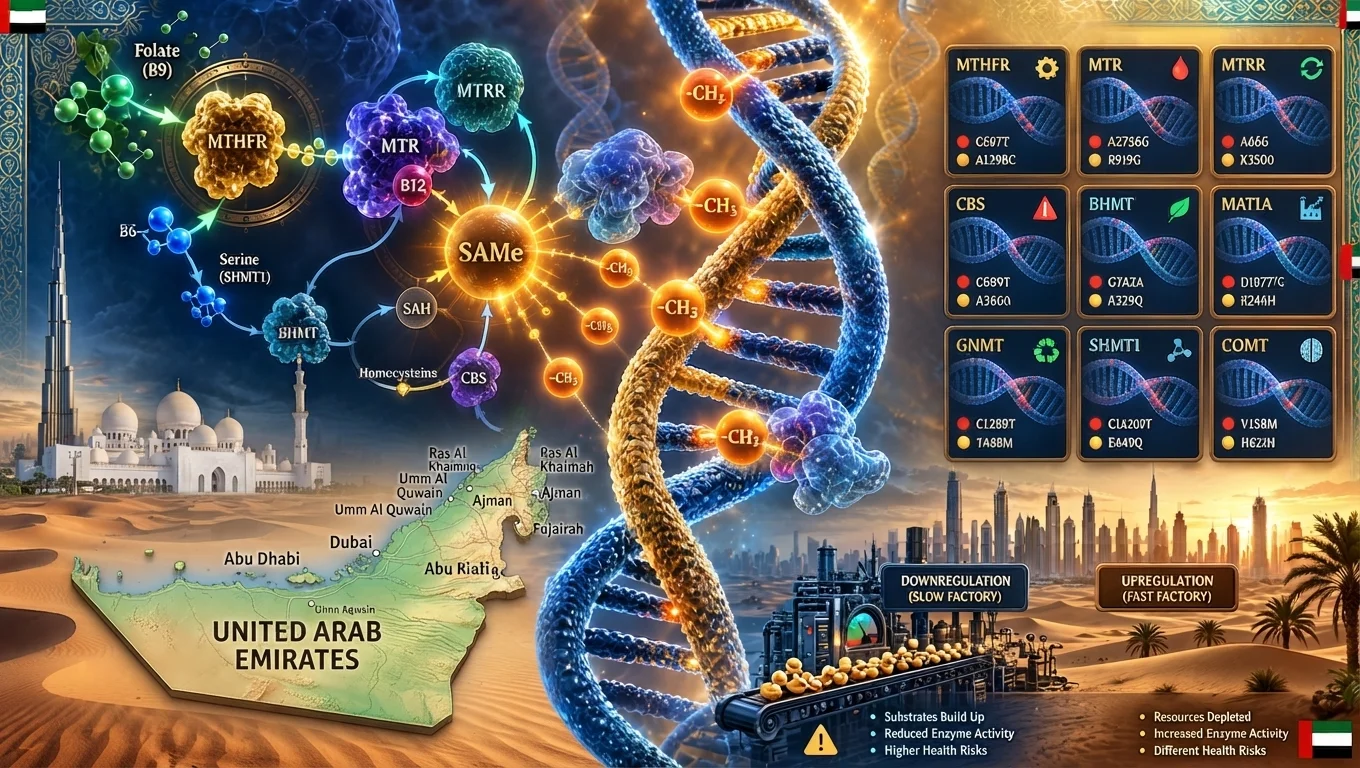
All of this runs on what biochemists call the one-carbon cycle — a folate- and B12-dependent loop that shuttles methyl groups between molecules. The genes below each control a different checkpoint in that loop.
The One-Carbon Cycle Gene Panel: Meet the Molecular Machinery
Folate Activation — MTHFR (C677T & A1298C)
MTHFR converts dietary folate into its active, usable form (5-MTHF), required to convert homocysteine back into methionine. Reduced MTHFR activity — seen with the C677T and A1298C variants — is one of the most researched links to elevated homocysteine, cardiovascular risk, and neural tube defect risk in pregnancy.
Case-control studies across Arab population groups report the heterozygous C677T (C/T) genotype in roughly a quarter to a third of individuals tested, with the homozygous T/T form appearing in a smaller minority — figures broadly comparable to, and in some cohorts higher than, Western populations. On top of this baseline frequency, the UAE's well-documented consanguinity rate raises the odds of an individual inheriting reduced-function copies of MTHFR from both parents, or carrying reduced-function variants across more than one methylation gene at once — a compounding effect that a single-gene test cannot capture on its own.
Homocysteine-to-Cysteine — CBS (C699T)
Cystathionine beta-synthase (CBS) diverts homocysteine down the transsulfuration pathway, converting it into cysteine and eventually glutathione, the body's master antioxidant. The C699T variant is generally associated with increased CBS activity, which can help clear homocysteine — but an overactive transsulfuration pathway also pulls methyl groups and sulfur amino acids away from the methylation cycle, sometimes increasing the need for B6 and molybdenum to keep downstream detox pathways balanced.
B12 Recycling — MTR and MTRR
MTR (methionine synthase) performs the final step that regenerates methionine from homocysteine, using vitamin B12 as a cofactor. MTRR keeps the B12-dependent form of MTR active. Variants such as MTRR A66G reduce B12 recycling efficiency, meaning a person may need more dietary or supplemental B12 to maintain normal methylation flux than someone without the variant.
This intersects sharply with regional epidemiology: large population studies in Abu Dhabi and Dubai report vitamin D and B12 insufficiency affecting the majority of residents tested, across both Emirati nationals and the expatriate community, despite the UAE's abundant year-round sunshine. A genetically less efficient B12-recycling step, layered on already-common nutrient insufficiency, compounds risk in a way a generic reference range does not reflect.
Liver Methylation Reserve — BHMT, MAT1A, and GNMT
These three genes govern a secondary, liver-dominant route for handling homocysteine and methyl groups:
- BHMT offers a folate-independent shortcut, using betaine to convert homocysteine to methionine. Upregulating variants can lower homocysteine efficiently but may draw down choline reserves faster than diet replenishes them.
- MAT1A converts methionine into SAMe, the master methyl donor. Reduced activity limits SAMe availability system-wide, with effects that are more pronounced alongside the high-fat dietary patterns common in the region.
- GNMT acts as a pressure-release valve, disposing of excess SAMe when methyl supply outpaces demand. An overactive GNMT variant can raise homocysteine again over time despite adequate folate and B12 status.
Genome Stability — SHMT1
SHMT1 sits at a fork in the one-carbon road: it can push folate toward nucleotide (DNA) synthesis or toward the methylation cycle. Variants that reduce SHMT1 activity favor methylation at the expense of nucleotide synthesis — a reminder that "more methylation" is not automatically the healthier direction for every gene in this pathway.
Neurotransmitter and Hormone Clearance — COMT (V158M)
COMT breaks down dopamine, adrenaline, noradrenaline, and estrogen metabolites using SAMe as its methyl donor. The V158M variant reduces COMT enzyme activity considerably, slowing clearance of these molecules. This has been studied in relation to mood regulation, stress resilience, pain sensitivity, and estrogen metabolism — making COMT one of the more clinically discussed genes outside the strict homocysteine conversation, even though it draws on the same SAMe pool as the rest of the pathway.
Upregulation vs. Downregulation: Why Direction Matters More Than "Good" or "Bad"
A common misconception is that every methylation gene variant is simply "faulty." In reality, each SNP either speeds up (upregulates) or slows down (downregulates) its enzyme, and both directions carry trade-offs:
- Downregulating variants (MTHFR C677T, MTRR A66G, MAT1A, COMT V158M) slow their enzyme, which can cause substrates like homocysteine or catecholamines to accumulate.
- Upregulating variants (CBS C699T, BHMT G742A, GNMT C1289T) speed up their enzyme, which can lower homocysteine but sometimes at the cost of depleting a related resource — choline, SAMe, or B6 — faster than diet supplies it.
This is why methylation genetics is never read gene-by-gene in isolation, and it is precisely why the UAE's consanguinity pattern matters clinically: a downregulating MTHFR variant paired with an upregulating CBS variant produces a very different biochemical picture than the same MTHFR variant paired with a downregulating CBS variant — and compound inheritance across several of these genes at once is more likely here than in an outbred population.
It is also worth being precise about what these associations mean: most of the links above — to cardiovascular disease, mood disorders, or pregnancy complications — come from population-level case-control studies. They describe statistical associations across large groups, not individual predictions. A variant shifts probability; it does not diagnose a condition or guarantee an outcome.
Why This Genetic Story Reads Differently in the UAE
Consanguinity & Compound Variants
The UAE has one of the world's higher documented consanguinity rates, contributing to a higher regional burden of inherited conditions and raising the likelihood of compound methylation-gene variants within the same family.
Widespread Nutrient Insufficiency
Large Abu Dhabi and Dubai cohort studies report vitamin D and B12 insufficiency in the majority of residents tested, despite abundant year-round sunshine — a pattern tied to lifestyle, clothing, and indoor-oriented daily routines.
High Cardiometabolic Load
The UAE has one of the highest Type 2 diabetes prevalence rates in the world, alongside high rates of cardiovascular risk factors — both conditions where homocysteine and methylation-pathway efficiency are actively researched contributors.
Put together, this means methylation genetics in the UAE cannot simply be interpreted by importing a Western or South Asian reference framework. The population structure and dietary backdrop change what a given SNP is likely to mean in practice — and change how much weight a compound, multi-gene result should carry.
Busting the Biggest Methylation Myth
Methylation genetics — and MTHFR in particular — has been heavily popularized in wellness and functional-medicine circles online, sometimes with claims that outpace the evidence: that a single MTHFR variant "causes" chronic fatigue or depression on its own, or that everyone with a variant needs aggressive supplementation.
The clinical reality is more measured. A gene variant describes potential enzyme efficiency — it does not replace measuring the actual downstream markers that matter: fasting homocysteine, active B12, folate status, and methylmalonic acid where indicated. Genetics tells you why a lab value might be trending a certain way; it is the biochemistry, interpreted by a qualified clinician, that tells you what to actually do about it.
From Genotype to Everyday Choices
Because this pathway is nutrient-dependent, several general, well-established levers influence how it functions day to day:
- Folate-rich whole foods support the MTHFR step, though the form of folate matters for those with reduced MTHFR activity.
- Reliable B12 intake is a priority given how widespread subclinical B12 insufficiency already is across the region.
- Sensible, regular sun exposure and dietary vitamin D sources address the separate but overlapping regional pattern of vitamin D insufficiency.
- Choline-containing foods (eggs, dairy) matter more for people with upregulated BHMT activity.
- Managing chronic stress matters for anyone with reduced COMT activity, since catecholamine clearance is already running slower.
These are general physiological principles, not individualized medical advice — the right approach for any one person depends on their actual genotype combination and lab markers together.
From Curiosity to Clarity
DNA methylation genetics is one of the rare areas where a single test result touches cardiovascular health, mental well-being, fertility, and liver function all at once — precisely because all of these systems draw from the same one-carbon, SAMe-dependent pool.
Reading these genes in isolation, or relying on a single SNP result popularized online, tells an incomplete story — especially in a population where compound, multi-gene inheritance is more common. A comprehensive methylation panel, mapping MTHFR, COMT, CBS, MTR/MTRR, BHMT, GNMT, MAT1A, and SHMT1 together alongside relevant biochemical markers, gives a far more accurate picture of how the one-carbon cycle is actually functioning. DNA Labs UAE's Methylation Gene Panel maps this full set of variants, so you and your physician can interpret them together as one connected system rather than a list of isolated genes.
Frequently Asked Questions
What is DNA methylation in simple terms?
DNA methylation is the process of attaching a small chemical tag — a methyl group — onto DNA and related molecules. It doesn't change your genetic code; it changes how genes are read and expressed, and it powers reactions like homocysteine clearance, neurotransmitter breakdown, and liver detoxification.
Is MTHFR gene variation common in the UAE?
Case-control studies across Arab population groups report the heterozygous MTHFR C677T genotype in roughly a quarter to a third of people tested, comparable to or higher than many Western populations. Combined with the UAE's higher consanguinity rate, the odds of inheriting reduced-function copies from both parents, or across more than one methylation gene, are clinically relevant here.
Why does consanguinity matter for methylation genetics specifically?
Consanguineous marriage increases the chance that a child inherits two copies of the same reduced-function variant, or reduced-function variants across several related genes at once, because both parents are more likely to carry the same regional genetic background. For a multi-gene pathway like methylation, this raises the value of testing the whole panel rather than a single gene.
Does the COMT gene affect mood?
The COMT V158M variant reduces the enzyme's ability to break down dopamine, adrenaline, and noradrenaline. Research has associated slower COMT activity with differences in stress resilience, mood regulation, and pain sensitivity, though it is one contributing factor among many, not a standalone diagnosis.
Can a methylation gene test diagnose a health condition?
No. A methylation panel reports genetic variants that influence enzyme efficiency and biochemical tendencies — it is not a diagnostic test for any disease. Meaningful interpretation requires pairing the genetic results with actual biochemical markers and a qualified clinician's assessment.
Why is vitamin B12 status so relevant to methylation genetics in the UAE?
Large Abu Dhabi and Dubai population studies report vitamin D and B12 insufficiency in a majority of residents tested, across both Emirati nationals and the wider expatriate community, despite abundant year-round sunshine. Since B12 is a required cofactor for the MTR/MTRR step of the methylation cycle, low B12 status combined with a reduced-function variant compounds the effect on homocysteine levels.
Recent Research Advances in Methylation-Related Treatment
Methylation science has moved well beyond nutritional supplementation in recent years. The following is presented for awareness, not as treatment advice.
Is there a precision-dosing approach for MTHFR carriers now, instead of a flat folic acid dose?
Yes — this is an active area of clinical trial research. The Precision Folic Acid Trial (PFAT-Hcy) is specifically testing genotype-adjusted folic acid dosing, building on earlier findings such as the China Stroke Primary Prevention Trial, which linked a roughly 20% reduction in homocysteine to a meaningful drop in stroke risk. This direction remains a clinical decision made with a physician, not a self-directed protocol.
Are there new therapies for severe, disease-level CBS deficiency (homocystinuria)?
Yes. Beyond long-standing dietary and vitamin-based management, recent developments include enzyme replacement therapy programs, pharmacological chaperone approaches designed to stabilize the CBS enzyme, and early-stage gene therapy candidates. This severe, disease-causing CBS deficiency is a distinct clinical entity from carrying a common CBS SNP like C699T, which has a far milder effect.
Have there been genuine advances in DNA-methylation-targeted cancer treatment?
Yes. DNA methyltransferase inhibitors such as azacitidine and decitabine, already established in blood cancers, are increasingly studied in combination with targeted therapies and immunotherapy. Newer research frontiers include epigenome-editing techniques and nanomedicine-based delivery systems designed to make these epigenetic drugs more targeted and better tolerated.
Can genetics now guide pain or antidepressant treatment based on COMT status?
This is an emerging but genuinely active clinical practice. Trials combining COMT genotype with other pharmacogenes to guide opioid dosing after surgery, or for chronic pain, have shown improved pain relief and fewer adverse events compared with standard prescribing. COMT genotype is also being studied within broader pharmacogenomic panels used to guide antidepressant selection. These approaches remain physician-directed.
Is methylation now being used for earlier disease detection, not just treatment?
Yes — detection is where some of the fastest recent progress has happened. Circulating tumor DNA methylation analysis and new single-cell and spatial methylation sequencing technologies are enabling earlier, more precise identification of methylation changes tied to cancer and other conditions, often before symptoms or standard biomarkers would flag a concern.
Corporate & Clinical Oversight
Clinical review: Dr. Lina Osama Zaki Quteineh, Consultant Medical Genetics, DHA Registration ID 9294403, DNA Labs UAE.
This article is intended for general health education and does not replace individualized medical advice.
Genetic variant information should always be interpreted alongside relevant clinical and biochemical testing, in consultation with a qualified healthcare provider.
Medically Reviewed by Dr. Shatha Janabi
DHA Licensed in Clinical Medicine
All content on DNA Labs UAE is reviewed by qualified medical professionals to ensure accuracy and compliance with clinical guidelines.
⚕️ Medical Disclaimer
This article is for informational purposes only and does not constitute medical advice. Always consult with a qualified healthcare professional for diagnosis and treatment.
Found this helpful? Book a test or consult our team.