
The Molecular Shift: How Liquid Biopsies are Redefining Cancer Diagnostics and Therapy
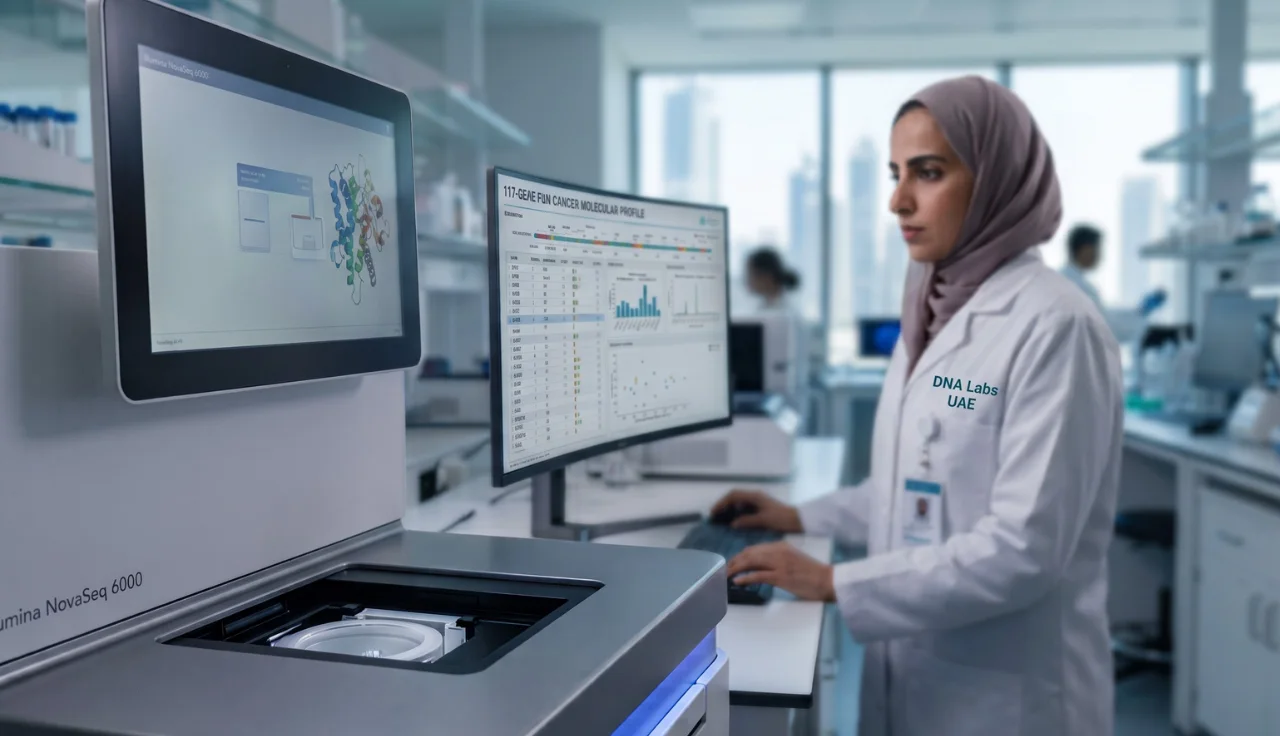
Liquid Biopsy: The 117-Gene Panel and the New Frontier of Non-Invasive Cancer Profiling
Physician Insight
"In my diagnostic practice here in the UAE, the convergence of advanced imaging and molecular pathology has fundamentally altered how we track cancer. While a PET/CT scan gives us the precise anatomical roadmap of a tumor's location and size, it cannot tell us the genetic machinery driving that growth. Liquid biopsies bridge this gap perfectly. When we utilize a 117-gene biopanel alongside traditional imaging, we are no longer just watching a tumor—we are reading its real-time biological blueprint, allowing us to pivot to targeted therapies without putting the patient through repeated, grueling surgical interventions."
When we discuss Liquid Biopsy in the UAE oncology landscape, we are addressing a monumental paradigm shift in precision cancer diagnostics. For decades, the cornerstone of oncological tissue diagnosis relied on invasive surgical procedures—core needle biopsies, excisional biopsies, or endoscopic tissue sampling. While historically effective and still clinically relevant, these approaches capture only a static snapshot of a tumor at a single moment in time and from a single spatial location. Today, the advent of liquid biopsy technology, utilizing advanced Next-Generation Sequencing (NGS) to analyze fragments of tumor DNA circulating in the bloodstream, enables clinicians to decode the complete molecular profile of a malignancy through a simple blood draw.
In the UAE, where medical infrastructure is increasingly focused on non-invasive, hyper-personalized patient care, the deployment of comprehensive genetic biopanels—such as the 117-Gene Panel—is transforming survival trajectories. It empowers oncologists with real-time biological intelligence, enabling the immediate selection of targeted therapies and the early detection of treatment resistance long before anatomical changes are visible on traditional imaging modalities.
Comprehensive oncogene panel covering SNVs, CNVs, and gene fusions
ctDNA shed from primary tumor and all metastatic deposits simultaneously
Procedure-related risk compared to invasive surgical tissue biopsy
The Biological Mechanics: Hunting for Circulating Tumor DNA
The scientific foundation of a liquid biopsy rests on the fundamental mechanisms of cellular lifecycle biology—specifically apoptosis (programmed cell death) and necrosis. As malignant tumors grow and proliferate, their characteristically high cell turnover rate causes dead and dying cancer cells to shed fragmented genetic material directly into the patient's circulatory system. This is known as circulating tumor DNA (ctDNA), and it represents a real-time molecular fingerprint of the malignancy.
Extracting and reading this ctDNA is an extraordinary molecular challenge. It exists in the bloodstream at extremely low concentrations, heavily diluted by the vastly more abundant normal, healthy cell-free DNA originating from non-malignant cells throughout the body. The comprehensive 117-Gene Panel utilizes deep sequencing technology—sequencing each target region thousands of times—to identify these rare cancer-derived DNA fragments with high sensitivity and specificity. The panel detects three major classes of clinically actionable genomic alterations:
Single Nucleotide Variants (SNVs)
- Definition: Point mutations—single base-pair changes in the DNA sequence—that drive cancer proliferation, survival, and metastasis.
- Clinical Examples: Activating mutations in KRAS (colorectal, pancreatic, and lung cancers), EGFR (non-small cell lung cancer), BRAF V600E (melanoma, colorectal cancer), and PIK3CA (breast cancer).
- Therapeutic Relevance: Many SNVs directly predict response or resistance to specific targeted therapies, making their identification essential for first-line treatment selection.
Copy Number Variations (CNVs)
- Definition: Amplifications (increased copy number) or deletions (loss) of specific gene regions, leading to altered gene dosage and protein expression levels.
- Clinical Examples: HER2 (ERBB2) amplification in breast and gastric cancers, MET amplification in lung cancer, MYC amplification across multiple tumor types.
- Therapeutic Relevance: HER2 amplification dictates eligibility for anti-HER2 targeted therapy (trastuzumab, trastuzumab deruxtecan). MET amplification can drive acquired resistance to EGFR inhibitors.
Gene Fusions
- Definition: Chromosomal rearrangements where two previously separate genes become abnormally joined, creating a chimeric fusion protein with oncogenic properties.
- Clinical Examples: ALK, ROS1, and RET fusions in non-small cell lung cancer (NSCLC), NTRK fusions across multiple solid tumors, and RET fusions in thyroid cancer.
- Therapeutic Relevance: These fusions are exquisitely sensitive to specific tyrosine kinase inhibitors—ALK inhibitors (alectinib, lorlatinib), ROS1 inhibitors (crizotinib, entrectinib), and NTRK inhibitors (larotrectinib, entrectinib).
Overcoming the Limitations of Tissue Biopsies
While tissue extraction remains a clinically relevant and often necessary diagnostic procedure, liquid biopsies resolve several critical bottlenecks that have historically compromised the precision oncology workflow. These limitations are not marginal—they directly impact treatment selection, clinical outcomes, and patient quality of life.
Addressing Tumor Heterogeneity
- The Problem: A traditional needle biopsy samples only a microscopic fraction of a single tumor site. Malignant tumors are biologically diverse—different regions of the same tumor, and different metastatic deposits, can harbor distinct driver mutations. A tissue biopsy from one region may completely miss critical actionable mutations present elsewhere.
- The Liquid Biopsy Solution: ctDNA is shed into the bloodstream from all tumor sites simultaneously—the primary mass, locoregional lymph node metastases, and distant hematogenous metastases. A single blood draw captures the composite molecular profile of the entire disease burden, providing a comprehensive rather than fragmented view of the cancer genome.
Surgical Risk and Anatomical Accessibility
- The Problem: Certain tumors arise in anatomical locations that make tissue extraction exceptionally dangerous or technically impossible. Deep-seated lung lesions adjacent to major vascular structures, brainstem gliomas, and retroperitoneal masses near the great vessels present prohibitive procedural risks including hemorrhage, pneumothorax, and neurological injury.
- The Liquid Biopsy Solution: A peripheral blood draw carries zero procedure-related risk and requires no anatomical targeting. It is repeatable indefinitely, enabling serial monitoring that would be unthinkable with repeated surgical biopsies.
"The synergy between advanced imaging and liquid biopsy is where modern oncology truly excels. PET/CT provides the anatomical roadmap—the precise location, size, and metabolic activity of every detectable lesion. But imaging cannot reveal which genetic drivers are fueling that activity. Liquid biopsy provides the biological narrative. Together, they transform cancer from a disease we can only see into a disease we can understand and target at the molecular level."
Clinical Indications: When Is the 117-Gene Panel Deployed?
The liquid biopsy is not a universal replacement for all cancer diagnostics—tissue biopsy remains essential for histological classification, tumor grading, and certain immunohistochemical assessments. However, the 117-Gene Panel is an indispensable tool in specific, high-stakes clinical scenarios where traditional approaches are inadequate or impossible.
Guiding First-Line Targeted Therapy
- Clinical Scenario: Standard tissue biopsy yields insufficient material for comprehensive molecular profiling—a situation described as Quantity Not Sufficient (QNS)—or tissue-based NGS fails due to poor DNA quality from formalin fixation.
- Clinical Action: Liquid biopsy provides the necessary mutational profile to initiate immunotherapy or targeted kinase inhibitors without requiring a repeat invasive procedure, which would delay treatment initiation.
Monitoring Acquired Resistance
- Clinical Scenario: Tumors evolve dynamically under the selective pressure of targeted therapy. Subclones harboring resistance mutations expand over time, eventually driving clinical progression.
- Clinical Action: Serial liquid biopsies detect newly acquired resistance mutations—such as EGFR T790M in EGFR-mutant lung cancer or KRAS G12C secondary mutations—months before anatomical progression becomes visible on CT or PET/CT, enabling early therapeutic pivots.
Minimal Residual Disease (MRD) Tracking
- Clinical Scenario: Following surgical resection with curative intent or completion of definitive chemotherapy, standard imaging and tumor markers cannot reliably detect microscopic residual disease.
- Clinical Action: Liquid biopsies identify trace levels of ctDNA that indicate persistent molecular disease, accurately stratifying patients into high-risk and low-risk groups for clinical relapse and potentially guiding adjuvant therapy decisions.
The UAE Oncology Context: Integrating Imaging and Genomics
The UAE's oncology infrastructure increasingly emphasizes the convergence of advanced diagnostic modalities to deliver truly personalized cancer care. The complementary relationship between high-resolution imaging—PET/CT, contrast-enhanced MRI, and CT—and comprehensive genomic profiling via liquid biopsy represents the cutting edge of this integration. Imaging defines the spatial extent of disease. Liquid biopsy defines the molecular drivers. Neither modality alone provides the complete picture; together, they enable oncologists to select the right targeted therapy for the right patient at the right time.
The 117-Gene Panel is specifically designed to cover clinically actionable genes with established therapeutic relevance, including targets with FDA-approved and EMA-approved therapies, genes associated with clinical trial eligibility, and key resistance mechanisms that inform therapeutic sequencing. This curated approach ensures that the genomic information generated translates directly into clinical decision-making.
The Path Forward: Precision Diagnostics for Precision Oncology
The era of empiric chemotherapy selection based solely on tumor histology and anatomical staging is being replaced by a more sophisticated paradigm: molecularly guided, biomarker-driven cancer care. Liquid biopsy is central to this transformation, providing real-time access to the cancer genome through a procedure that is safe, repeatable, and comprehensive.
For patients in the UAE facing a new cancer diagnosis, treatment failure, or surveillance after curative therapy, the 117-Gene Panel offers a window into the molecular machinery of their disease. It identifies actionable targets, monitors the emergence of resistance, and detects residual disease before it becomes clinically apparent—all without the risks, discomfort, and logistical challenges of repeat tissue biopsy.
Precision medicine demands precision diagnostics. By profiling 117 critical oncology genes from a single blood draw, patients and clinicians can unlock personalized, evidence-based treatment pathways and navigate the evolving landscape of cancer with molecular clarity.
Medically Reviewed by Dr. Dr. Prabhakar Reddy Kalathoor
DHA Licensed in Clinical Medicine
All content on DNA Labs UAE is reviewed by qualified medical professionals to ensure accuracy and compliance with clinical guidelines.
⚕️ Medical Disclaimer
This article is for informational purposes only and does not constitute medical advice. Always consult with a qualified healthcare professional for diagnosis and treatment.
Found this helpful? Book a test or consult our team.