
The Complete Food Intolerance & Allergy Panel: Uncovering Hidden Dietary Triggers
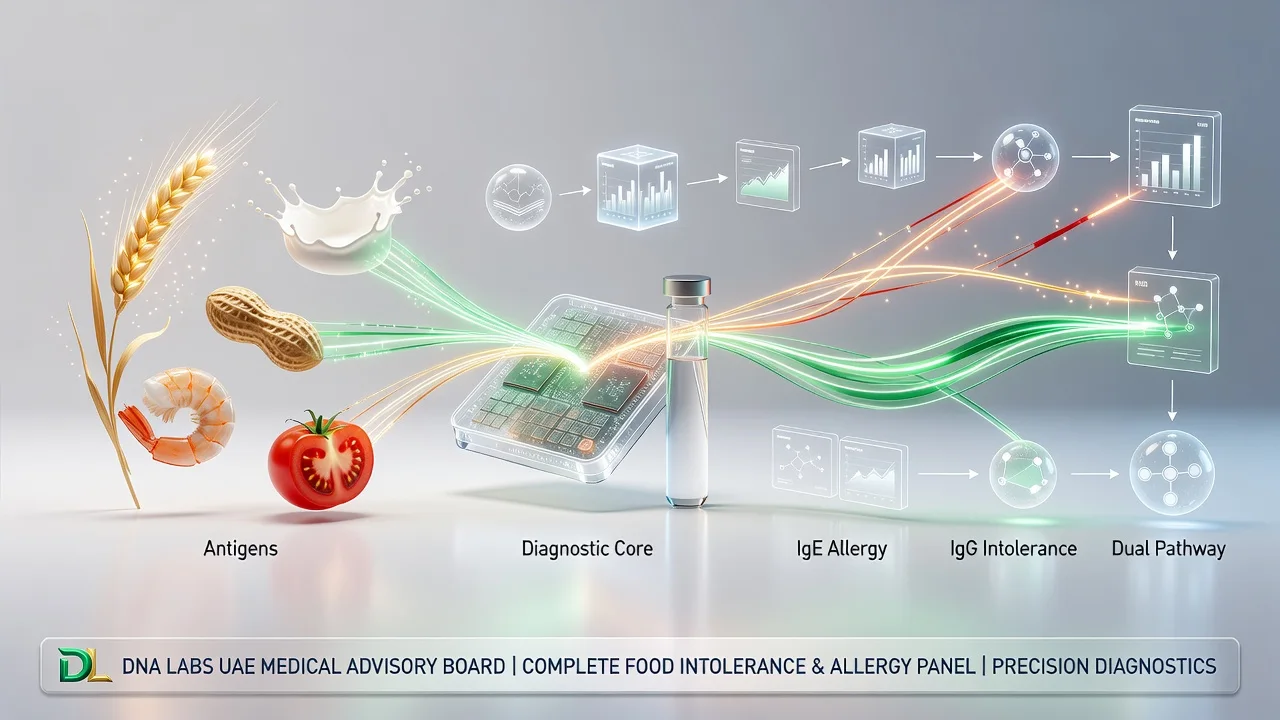
The Complete Food Intolerance & Allergy Panel: Uncovering Hidden Dietary Triggers
Physician Insight
"Guessing which foods are causing chronic inflammation or acute distress is a dangerous and exhausting game of trial and error. Patients often eliminate vital nutrient sources based on a hunch, only to feel worse. By utilizing a comprehensive serological panel that simultaneously maps both the acute IgE allergic pathways and the delayed IgG intolerance pathways, we completely remove the guesswork. We replace restrictive, generalized diets with empirical, personalized laboratory data."
When we discuss comprehensive food reactivity testing in the UAE, we are addressing one of the most persistent and frustrating challenges in modern clinical practice: the patient who has tried everything, eliminated entire food groups, consulted multiple specialists, and still suffers from unexplained gastrointestinal distress, chronic fatigue, or stubborn skin conditions. The issue is rarely a lack of effort—it is a lack of comprehensive, unified diagnostic data.
The clinical reality is that a single patient can simultaneously harbor a severe, immediate IgE-mediated allergy to one food—such as shellfish—while quietly suffering from a delayed, low-grade IgG-mediated intolerance to a seemingly healthy daily staple like lentils, eggs, or specific dairy proteins. Evaluating only one immune pathway leaves the other completely invisible, resulting in an incomplete clinical picture and persistent symptoms.
Simultaneous IgE and IgG assessment in a single blood draw
Regional and international food antigens screened comprehensively
Detection window for delayed IgG reactions invisible to food diaries
The Diagnostic Need for a Unified Panel
Historically, patients suffering from food-related ailments were forced to undergo multiple, separate tests—often producing fragmented data that no single clinician could synthesize into a coherent clinical picture. An allergist would test for IgE responses. A gastroenterologist might investigate enzymatic deficiencies. A nutritionist would recommend an elimination diet based on educated guesswork. The result was a patient navigating three different diagnostic frameworks, none of which communicated with the others.
The Complete Food Intolerance & Allergy Panel eliminates this fragmentation. By analyzing a single blood sample for both rapid-onset allergic markers (IgE) and delayed-onset intolerance markers (IgG) against hundreds of food proteins simultaneously, clinicians can pinpoint the exact origin of a patient's systemic, dermatological, or gastrointestinal distress in one comprehensive serological run. This is not merely convenient—it is diagnostically superior, revealing cross-pathway reactivity patterns that isolated testing would inevitably miss.
"The true power of this panel lies in its breadth. By screening against hundreds of local and international food antigens simultaneously, we often discover that the culprit behind a patient's chronic fatigue isn't gluten, but a highly specific spice, seed, or additive they consume daily. These are triggers that would never surface on a standard limited panel."
The Dual-Antibody Evaluation: What the Panel Measures
The human immune system can react to food proteins through multiple distinct mechanisms. A complete diagnostic approach must evaluate both pathways simultaneously to produce a clinically useful map of dietary reactivity.
Immunoglobulin E (IgE) Screening
- Pathway: Identifies antibodies responsible for immediate, histamine-driven allergic reactions.
- Clinical Significance: Crucial for identifying foods that pose acute, immediate threats—urticaria, angioedema, respiratory distress, or anaphylaxis—occurring within minutes to two hours of ingestion.
- Management Implication: Positive IgE results typically indicate the need for strict, lifelong avoidance and emergency preparedness with epinephrine.
Immunoglobulin G (IgG) Screening
- Pathway: Measures antibodies responsible for delayed inflammatory responses, forming circulating immune complexes that deposit in tissues.
- Clinical Significance: These reactions can take up to 72 hours to manifest, making them nearly impossible to identify through food diaries or elimination diets alone. Frequently linked to chronic gut, skin, neurological, and musculoskeletal conditions.
- Management Implication: Positive IgG results typically guide temporary elimination protocols with gut healing and structured reintroduction—not permanent avoidance.
Clinical Indicators: When Is This Test Recommended?
Physicians typically recommend the Complete Food Intolerance & Allergy Panel when a patient presents with a constellation of unresolved symptoms that have not responded to standard medical treatments or generalized dietary advice. The test is particularly valuable for identifying stealth triggers in the diverse, multicultural diets common across the UAE, where a single meal may incorporate ingredients spanning multiple continents and food families.
Gastrointestinal Dysregulation
- Chronic bloating, excessive gas, and abdominal distension
- Unpredictable bowel habits—alternating diarrhea and constipation
- Symptoms frequently misdiagnosed as Irritable Bowel Syndrome (IBS)
- Post-meal cramping and unresolved nausea
- Early satiety and unexplained weight fluctuations
Systemic & Dermatological Signs
- Stubborn skin conditions—eczema, rosacea, chronic acne
- Unexplained chronic fatigue, lethargy, and cognitive "brain fog"
- Recurrent migraines or tension headaches linked to meals
- Joint stiffness and localized inflammatory pain
- Mood disturbances and sleep disruption without psychiatric cause
Inside the Laboratory: How the Complete Panel Works
The Complete Food Intolerance & Allergy Panel utilizes advanced multiplex technology or highly sensitive Enzyme-Linked Immunosorbent Assays (ELISA). From a simple blood draw, laboratory technicians extract the serum and expose it to a vast array of purified food proteins arranged on a micro-array plate.
If the patient's blood contains antibodies against a specific food—whether a dairy protein, a particular nut variety, a nightshade vegetable, or a grain—a measurable binding reaction occurs. The laboratory equipment quantifies this reaction with precision, producing a detailed report that categorizes foods into clinically meaningful severity zones: Elevated, Borderline, and Normal. This stratification allows clinicians to prioritize interventions, distinguishing between foods that require immediate elimination and those that may be tolerated in moderation or on a rotational basis.
For a full directory of the specific food antigens tested, specimen collection requirements, and analytical validation specifications, consult the official test page.
Translating Diagnostics into Clinical Relief
A diagnostic test is only as valuable as the clinical strategy it informs. The results of the Complete Panel provide a highly precise, data-driven roadmap for dietary modification that stands in stark contrast to the generalized elimination diets that dominate popular wellness culture.
1. Precision Elimination
Patients safely remove only the specific foods flagged as highly reactive by the laboratory, preserving nutritional balance by not avoiding safe food groups unnecessarily. No more eliminating entire categories based on guesswork.
2. Gut Mucosal Repair
With the inflammatory dietary triggers removed, the gastrointestinal lining is given the necessary window to heal, reducing systemic immune hyper-reactivity and restoring normal intestinal permeability.
3. Strategic Reintroduction
For IgG intolerances—unlike true IgE allergies—clinicians can often guide patients through a phased reintroduction protocol to safely test tolerance thresholds once the immune system has settled.
Clinical Distinction: Unlike IgE-mediated food allergies, which typically require lifelong strict avoidance, IgG-mediated food intolerances are often reversible. By removing the inflammatory trigger, healing the gut lining, and methodically reintroducing foods under clinical supervision, many patients can eventually tolerate previously problematic foods in moderation. The goal is immunological recalibration, not permanent dietary deprivation.
The UAE Dietary Context: Why Comprehensive Testing Matters
The UAE's unique culinary landscape—where Emirati, Levantine, South Asian, East Asian, and Western dietary traditions intersect daily—creates an exceptionally complex antigen exposure profile. A patient may react to spices common in one cuisine, dairy proteins present across multiple food cultures, or legumes that appear in everything from hummus to dal to plant-based protein alternatives.
Narrow or single-pathway testing designed for homogeneous Western diets frequently misses the triggers most relevant to patients in the Gulf region. A comprehensive panel that includes regional staples—specific grains, legumes, spices, and preparation methods—provides the cultural and dietary specificity that generalized international panels cannot.
The Path Forward: From Suffering to Strategy
Living with undiagnosed food reactivity is exhausting—not just physically, but psychologically. The constant uncertainty about which foods are safe, the social limitations, the frustration of trying diet after diet without lasting relief. Comprehensive serological testing replaces this uncertainty with empirical data, transforming a vague, overwhelming problem into a specific, manageable clinical strategy.
If you are experiencing persistent gastrointestinal symptoms, unexplained fatigue, skin conditions, migraines, or joint pain that have resisted diagnosis and conventional treatment, the Complete Food Intolerance & Allergy Panel provides the unified diagnostic foundation needed to move from suffering to evidence-based action.
Medically Reviewed by Dr. Lina Osama Zaki Quteineh
DHA Licensed in Clinical Medicine
All content on DNA Labs UAE is reviewed by qualified medical professionals to ensure accuracy and compliance with clinical guidelines.
⚕️ Medical Disclaimer
This article is for informational purposes only and does not constitute medical advice. Always consult with a qualified healthcare professional for diagnosis and treatment.
Found this helpful? Book a test or consult our team.