
Closing the Window Period: The Clinical Superiority of HIV RNA PCR Qualitative Testing
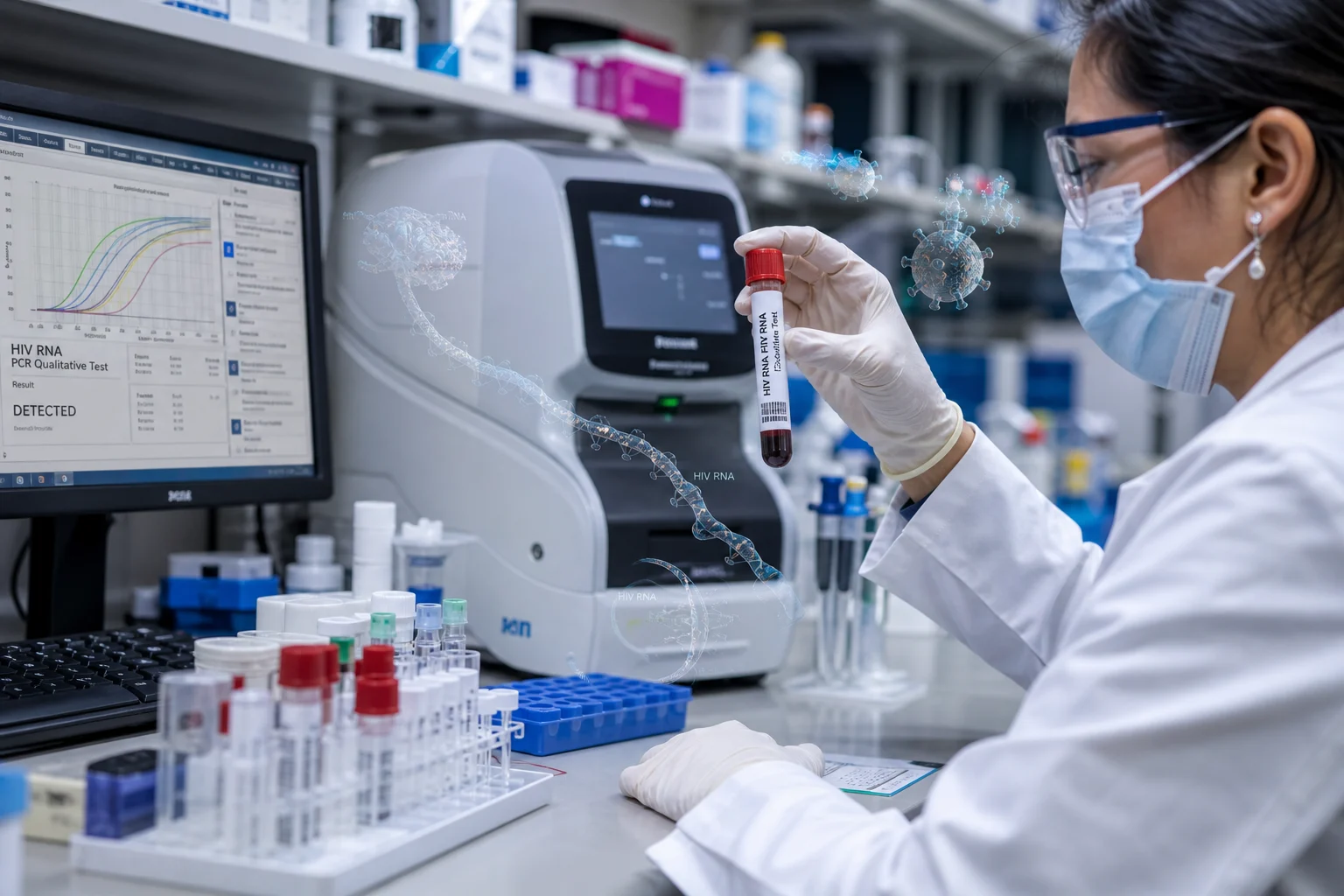
HIV RNA PCR Qualitative Test: Early Detection Through Direct Viral Molecular Diagnostics
Physician Insight
"In my daily practice across the UAE, the anxiety associated with a potential HIV exposure is one of the most acute psychological burdens a patient can carry. Telling a patient they must wait a month for a standard antibody test is often agonizing for them. By utilizing the HIV RNA PCR Qualitative test, we dramatically shorten that window of uncertainty to just over a week. This molecular precision not only provides rapid peace of mind for the vast majority of our patients but also allows us to initiate life-saving interventions immediately for the few who require it."
When we discuss early HIV detection in the UAE, we are addressing one of the most psychologically charged periods in clinical medicine—the interval between a potential exposure to the Human Immunodeficiency Virus and the moment a patient can receive a definitive answer about their status. Historically, the medical community relied on antibody-based tests that detect the host immune response to the virus. These assays, while effective for routine screening, impose a waiting period of weeks or even months for the immune system to produce a detectable antibody response—a delay clinically known as the "window period."
Today, the HIV RNA PCR Qualitative Test represents a quantum leap in early diagnostic capabilities. Rather than waiting for the body's immune reaction, this molecular assay directly identifies the genetic material of the virus itself—HIV-1 RNA—in the patient's blood plasma. By compressing the detection window to just 9 to 14 days post-exposure, this qualitative molecular assessment provides unparalleled clinical clarity, enabling immediate medical intervention or definitive peace of mind far earlier than traditional screening paradigms. In the UAE, where a highly mobile, expatriate-heavy population demands rigorous, confidential, and rapid healthcare solutions, cutting-edge molecular diagnostics are no longer a luxury—they are an essential component of responsible public health.
Detection window post-exposure compared to 18–45 days for antibody tests
Detects virus genetic material rather than waiting for host immune response
Definitive detected or not detected answer for diagnostic clarity
The Biological Mechanics: Why PCR Outperforms Standard Screening
To understand the superiority of the RNA PCR test, we must examine the biology of early viral infection and the fundamental difference between detecting a pathogen directly versus detecting the host's immunological response to it. When HIV enters the bloodstream, it rapidly begins replicating its genetic material—Ribonucleic Acid, or RNA—using the host's cellular machinery. Viral RNA becomes detectable in plasma within days of infection, reaching high levels during the acute phase before the immune system has mounted any measurable response.
However, it takes an average of 18 to 45 days for the human body to recognize this viral invader and produce sufficient quantities of antibodies to be detected by standard 3rd-generation (antibody-only) or even 4th-generation (antigen/antibody combination) screening assays. This immunological lag—the window period—represents a diagnostic void during which a patient may be highly infectious yet test negative on conventional screening. The Polymerase Chain Reaction (PCR) Qualitative Test bypasses the immune system entirely by targeting the virus directly. The laboratory process involves three precisely orchestrated molecular stages:
1. Extraction
Viral RNA is isolated directly from the patient's blood plasma using specialized techniques that preserve the integrity of the nucleic acid while removing cellular debris, proteins, and potential PCR inhibitors. The quality of extraction directly determines the sensitivity of the downstream assay.
2. Reverse Transcription
Because HIV is an RNA virus and PCR amplification requires DNA as a template, the viral RNA is converted into complementary DNA (cDNA) using the enzyme reverse transcriptase. This critical step creates a stable DNA copy of the viral genetic target that can be exponentially amplified in the subsequent PCR reaction.
3. Amplification & Detection
The PCR machine, using primers specific to conserved regions of the HIV-1 genome, exponentially copies the target genetic sequence through repeated thermal cycling. Each cycle doubles the number of target DNA molecules. Even a minuscule trace of the virus—as few as 20–50 viral copies per milliliter—is amplified into a clearly detectable fluorescent signal, generating a definitive positive or negative result.
"The elegance of RNA PCR lies in its ability to detect the virus during the acute phase of infection—the period of peak viremia when viral RNA levels can exceed 10 million copies per milliliter. This is when the patient is most infectious to others and when a standard antibody test, paradoxically, is most likely to yield a false-negative result. Molecular diagnostics resolve this dangerous diagnostic paradox."
Qualitative vs. Quantitative PCR: Understanding the Clinical Distinction
In the realm of HIV molecular diagnostics, PCR testing is divided into two distinct clinical pathways that serve fundamentally different purposes at different stages of the patient journey. Confusing these modalities can lead to inappropriate test selection and diagnostic delay.
Qualitative PCR: The Detector
- Clinical Purpose: Diagnostic screening—designed strictly to answer a definitive binary question: Is HIV-1 RNA present in the patient's blood? Yes or No.
- Engineering Priority: Maximum analytical sensitivity to detect the absolute lowest threshold of the virus. The assay is optimized to minimize false-negative results during the critical early window when viral levels may still be rising.
- Primary Indications: Early post-exposure testing (9–14 days), infant diagnosis where maternal antibodies confound serological testing, resolution of indeterminate antibody results, and confirmation of acute retroviral syndrome.
- Result Format: Reported as "Detected" or "Not Detected"—a binary qualitative outcome that provides immediate clinical clarity without numerical viral load data.
Quantitative PCR: The Monitor
- Clinical Purpose: Disease monitoring—measures the exact viral load in copies per milliliter of plasma once infection is confirmed.
- Engineering Priority: Accurate quantification across a wide dynamic range to track viral suppression on Antiretroviral Therapy (ART).
- Primary Indications: Baseline viral load assessment before ART initiation, monitoring treatment response and adherence, confirming viral suppression to undetectable levels (<20–50 copies/mL), detecting virological failure and drug resistance, and confirming Undetectable = Untransmittable (U=U) status.
- Result Format: Reported as a numerical value—copies of HIV RNA per milliliter of plasma—with trends over time providing the clinically actionable information.
Clinical Indications: Who Should Request an RNA PCR Qualitative Test?
While routine annual screenings and general health checks can be appropriately managed with standard 4th-generation antigen/antibody combination tests, the RNA PCR Qualitative assay is strictly indicated for acute, high-priority clinical scenarios where the window period of serological testing is clinically unacceptable. The decision to deploy molecular testing should be guided by a careful assessment of exposure history, timeline, and clinical presentation.
- Recent High-Risk Exposure: Individuals who have had unprotected sexual contact, shared injection equipment, or sustained occupational exposure—such as a needlestick injury or mucosal splash in a healthcare setting—within the preceding 10 to 14 days and who cannot afford to wait the additional weeks required for antibody seroconversion. This is the single most common indication for qualitative RNA PCR in the UAE clinical context.
- Acute Retroviral Syndrome Symptoms: Patients presenting with early clinical signs of primary HIV infection shortly after a potential exposure. These symptoms—which reflect the initial burst of viral replication and the host's innate immune response—include unexplained high fever, severe fatigue and malaise, generalized lymphadenopathy (swollen lymph nodes), maculopapular rash, pharyngitis, myalgia, and headache. This syndrome is frequently misdiagnosed as influenza or infectious mononucleosis, but its occurrence in the context of recent risk behavior demands immediate molecular testing.
- Resolving Indeterminate Serological Results: When a rapid test or standard 4th-generation screening assay yields ambiguous, discordant, or repeatedly borderline results, RNA PCR acts as the definitive molecular tiebreaker. A negative RNA PCR in the setting of an indeterminate antibody test effectively excludes acute HIV infection, while a positive result confirms it and mandates immediate linkage to care.
- Infant Diagnosis: Infants born to HIV-positive mothers carry passively transferred maternal antibodies that persist for up to 18 months, rendering antibody-based tests useless for determining whether the infant is infected. Qualitative RNA PCR is the gold standard for infant diagnosis, typically performed at birth, 2–4 weeks, and 4–6 weeks of age per international guidelines.
The UAE Context: Confidentiality, Speed, and Public Health
The UAE's unique demographic landscape—a highly mobile population with significant expatriate communities, international business travelers, and a robust healthcare sector employing professionals from across the globe—creates a specific set of requirements for HIV diagnostics. Testing must be rapid to accommodate patients who may be in the country for limited periods. It must be rigorously confidential to address the personal and professional sensitivities associated with HIV testing. And it must be accurate to avoid the devastating consequences of a false-negative result during the window period, when a patient may unknowingly transmit the virus to others.
The HIV RNA PCR Qualitative Test meets all three requirements. Results are typically available within 48–72 hours of sample collection. The binary qualitative format provides unambiguous diagnostic clarity. And by compressing the detection window to 9–14 days, it dramatically reduces the period of diagnostic uncertainty that has historically been the most challenging aspect of post-exposure HIV assessment.
The Path Forward: From Diagnostic Uncertainty to Clinical Clarity
The psychological burden of waiting for HIV test results during the window period cannot be overstated. Patients describe this interval as one of the most distressing experiences of their lives—a period marked by hypervigilance, catastrophic thinking, social withdrawal, and functional impairment. Traditional antibody-based testing, by mandating a wait of 18 to 45 days for seroconversion, prolongs this suffering unnecessarily when molecular alternatives exist.
The HIV RNA PCR Qualitative Test transforms this experience. By providing a definitive answer within two weeks of exposure, it either delivers rapid peace of mind for the vast majority of patients whose results are negative, or it enables immediate entry into care—initiation of Antiretroviral Therapy (ART), partner notification, and prevention of further transmission—for the small minority whose results are positive. In both scenarios, early diagnosis is the gateway to optimal outcomes.
Infectious disease diagnostics require the highest level of laboratory precision and absolute patient confidentiality. To understand the testing timeline, laboratory methodology, and clinical parameters of early HIV detection, we invite you to explore our specialized virology panel.
Medically Reviewed by Dr. Dr. Prabhakar Reddy Kalathoor
DHA Licensed in Clinical Medicine
All content on DNA Labs UAE is reviewed by qualified medical professionals to ensure accuracy and compliance with clinical guidelines.
⚕️ Medical Disclaimer
This article is for informational purposes only and does not constitute medical advice. Always consult with a qualified healthcare professional for diagnosis and treatment.
Found this helpful? Book a test or consult our team.