
Beta Thalassemia HBB Full Gene Analysis
Expert Insight: Review by Ajay Singh, General Practitioner (DHA ID: 36234132)
The HBB Gene and Beta Thalassemia: Why Full Gene Analysis Matters for UAE Families
In the diverse genetic landscape of the UAE, where consanguinity and regional founder mutations shape hereditary disease profiles, beta thalassemia remains one of the most significant inherited hemoglobin disorders. The HBB full gene analysis by Sanger sequencing provides the definitive molecular diagnosis, offering 99.9% sensitivity for detecting nucleotide changes that cause this condition.
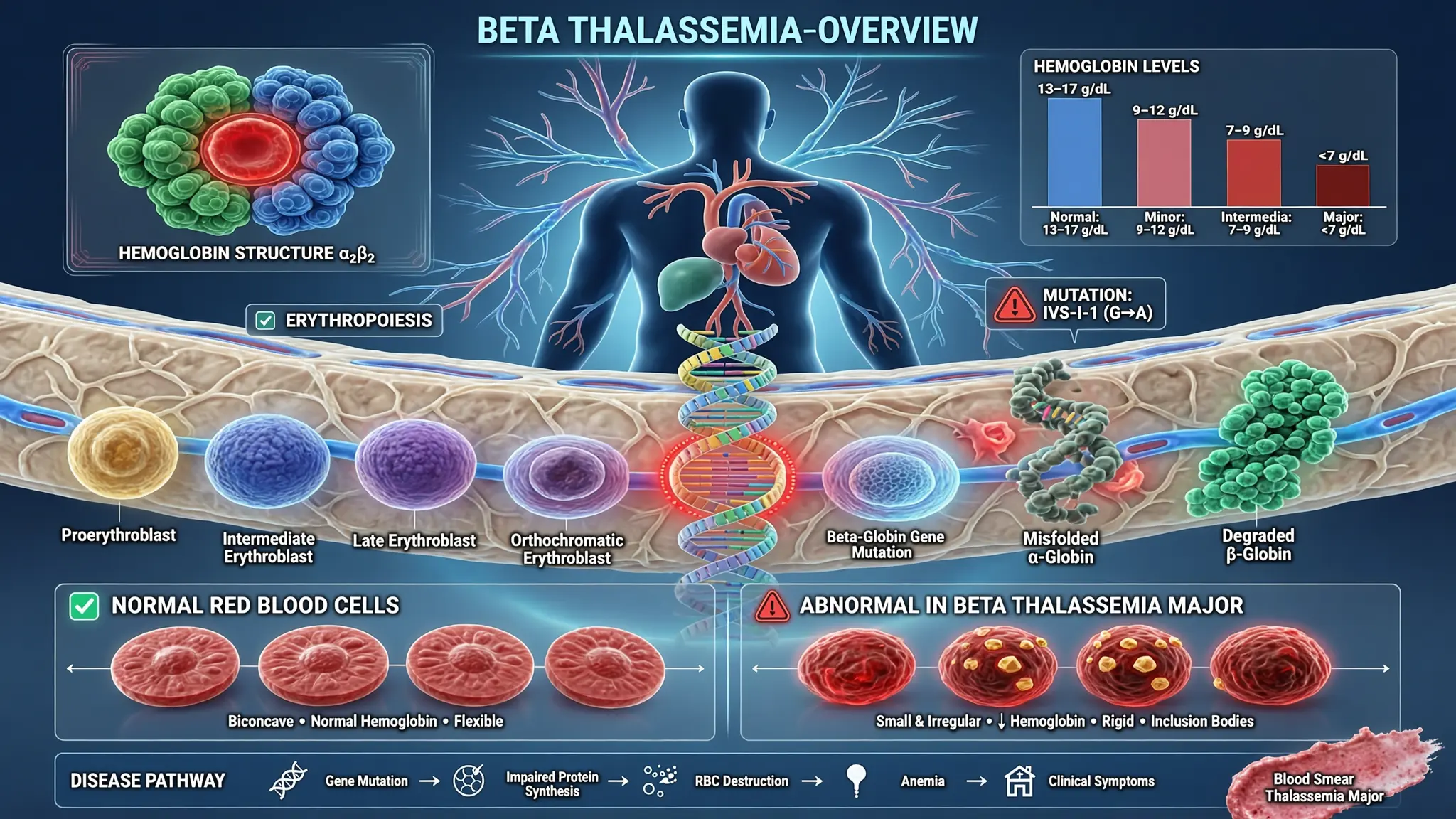
Beta thalassemia is caused by mutations in the HBB gene, which provides instructions for making beta-globin—a critical subunit of hemoglobin. These genetic variants lead to reduced (beta+) or absent (beta0) beta-globin chain production, resulting in ineffective erythropoiesis and chronic anemia. Full gene sequencing is the gold-standard test that comprehensively evaluates all coding regions and splice sites, detecting both common variants and rare, family-specific mutations that targeted panels often miss.
🧬 Physician Insight
"HBB full gene analysis is the definitive molecular test for beta thalassemia. It identifies known pathogenic variants and reveals rare mutations that are essential for accurate genetic counseling and reproductive decision-making. A genetic result, however, must always be interpreted alongside hematological parameters and family history."
— Ajay Singh, General Practitioner (DHA Registration ID: 36234132)
The Biology of Beta Thalassemia: Understanding the HBB Gene
Hemoglobin, the oxygen-carrying protein in red blood cells, is a tetramer composed of two alpha-globin and two beta-globin chains. The HBB gene on chromosome 11 encodes the beta-globin chain. Mutations in HBB disrupt beta-globin synthesis, creating an imbalance between alpha and beta chains.
This chain imbalance leads to precipitation of excess alpha-globin chains, damaging red blood cell membranes and causing intramedullary destruction of erythroid precursors. Clinically, this manifests as:
- Beta Thalassemia Major (Cooley's Anemia): Severe, transfusion-dependent anemia presenting in the first two years of life with symptoms including jaundice, failure to thrive, skeletal deformities, and hepatosplenomegaly.
- Beta Thalassemia Intermedia: A milder phenotype requiring intermittent transfusions, often influenced by secondary genetic modifiers.
- Beta Thalassemia Minor (Trait): Asymptomatic or mild microcytic anemia, often detected incidentally on routine blood work.
Carrier frequency in the UAE population is notably elevated due to historical malaria resistance, with recent studies indicating that up to 8.5% of the local population may carry an HBB mutation. Full gene sequencing is essential for accurately identifying carriers, particularly in premarital and preconception screening programs.
Why Full Gene Analysis Outperforms Targeted Mutation Panels
Many laboratories offer targeted mutation panels that screen for a predefined set of common HBB mutations, typically 10-20 variants. While these panels can identify most mutations in certain ethnic groups, they have significant limitations for the genetically diverse UAE population.
The HBB full gene analysis sequences the entire coding region and flanking intronic splice sites using bi-directional Sanger sequencing. This approach offers several critical advantages:
- Detection of all point mutations and small indels: Unlike targeted panels, full sequencing captures the full spectrum of over 400 known HBB mutations, including rare private family variants.
- Definitive diagnostic confirmation: For patients with unexplained microcytic anemia and elevated HbA2, full sequencing provides a conclusive molecular diagnosis.
- Accurate genetic counseling: Identifying the exact mutation enables precise risk assessment for family members and informs reproductive options.
- Limitation awareness: Sanger sequencing does not reliably detect large deletions, duplications, or deep intronic variants, which require additional deletion/duplication analysis or MLPA testing.
Full gene sequencing detects approximately 90% of all pathogenic variants in the HBB gene, with most remaining 10% represented by large structural rearrangements identifiable through complementary MLPA analysis.
Clinical Applications in the UAE: From Carrier Screening to Prenatal Diagnosis
In the UAE, beta thalassemia screening is a cornerstone of the national premarital screening program, which mandates testing for hemoglobinopathies. However, routine hematological screening alone may not identify all carriers, particularly those with silent beta-thalassemia trait or concurrent iron deficiency.
Key clinical applications of HBB full gene analysis include:
- Premarital and preconception carrier screening: Couples can determine their carrier status and assess the 25% risk of having a child with beta thalassemia major if both partners are carriers.
- Prenatal diagnosis: For couples at risk, prenatal testing can identify affected fetuses, enabling informed decision-making and early management planning.
- Confirmation of clinical diagnosis: For individuals with a clinical suspicion of beta thalassemia based on CBC and hemoglobin electrophoresis findings.
- Evaluation of transfusion-dependent anemia: Genetic testing helps distinguish beta thalassemia from other inherited anemias and identifies mutations associated with more severe phenotypes.
Expert guidelines recommend HBB gene sequencing for all pregnant women with anemia and concurrent suspicion of thalassemia, as well as for individuals with unexplained microcytic anemia despite normal iron studies.
UAE Regulatory and Data Protection Compliance
This test adheres to Dubai Health Authority (DHA) regulations and UAE federal law requirements governing genetic testing:
- Federal Decree-Law No. 45 of 2021 on Personal Data Protection (PDPL): Genetic data is encrypted, access-controlled, and protected.
- Federal Decree-Law No. 4 of 2016 on Medical Liability: Clinical safety protocols governed by federal standards.
- Federal Law No. 2 of 2019: Health information and communication technology standards.
- ISO 9001:2015 accreditation: Laboratory processes validated for diagnostic accuracy.
Clinical Interpretation and Multidisciplinary Correlation
A positive result from HBB full gene analysis identifies the specific pathogenic variants present. However, the clinical interpretation and correlation with phenotype require integration of multiple factors:
- Hematological parameters: Complete blood count, hemoglobin electrophoresis (HbA, HbA2, and HbF levels), and iron studies.
- Family history: Pedigree analysis to determine inheritance patterns and assess risk for other family members.
- Modifier genes: Co-inherited genetic factors, such as alpha-globin gene deletions or polymorphisms that increase HbF production, can modulate disease severity.
A genetic result should never be used in isolation; it requires correlation with hematological parameters and pedigree analysis. Every patient must receive post-test genetic counseling to understand recurrence risks and reproductive options, including preimplantation genetic testing or prenatal diagnosis.
Expert Oversight & Clinical Governance
Clinical Interpretation: All genetic results are reviewed and signed off by a Consultant Medical Geneticist licensed by the Dubai Health Authority (DHA), ensuring variant classification adheres to ACMG/AMP guidelines.
Corporate Oversight: DNA Labs UAE operates under a DHA-licensed facility (License No. 1143) at Dubai Healthcare City, complying with all federal and local regulations for genetic testing and data privacy.
The Path to a Definitive Diagnosis
Beta thalassemia is a manageable condition when diagnosed early. HBB full gene analysis offers the definitive molecular diagnosis, enabling accurate risk assessment, timely intervention, and informed reproductive decision-making for UAE families.
With the prevalence of beta thalassemia in the UAE population and the public health imperative for carrier screening, full gene sequencing remains the gold standard for diagnosis. This test empowers couples, families, and healthcare providers with the genetic knowledge needed to prevent and manage this condition effectively.
References
1. GTR Test ID: GTR000530702.2 — Beta-Thalassemia: HBB (Full Gene Sequencing). National Center for Biotechnology Information (NCBI).
2. Beta Thalassemia HBB Full Gene Analysis (Single). DNA Labs UAE.
3. β-Thalassemia: HBB (Full Gene Sequencing). Labcorp Women's Health.
4. Thalassemia beta. Amedes Genetics.
5. MedGenome. Thalassemia Mutation Testing Brochure.
Medically Reviewed by Dr. Lina Osama Zaki Quteineh
DHA Licensed in Clinical Medicine
All content on DNA Labs UAE is reviewed by qualified medical professionals to ensure accuracy and compliance with clinical guidelines.
⚕️ Medical Disclaimer
This article is for informational purposes only and does not constitute medical advice. Always consult with a qualified healthcare professional for diagnosis and treatment.
Found this helpful? Book a test or consult our team.