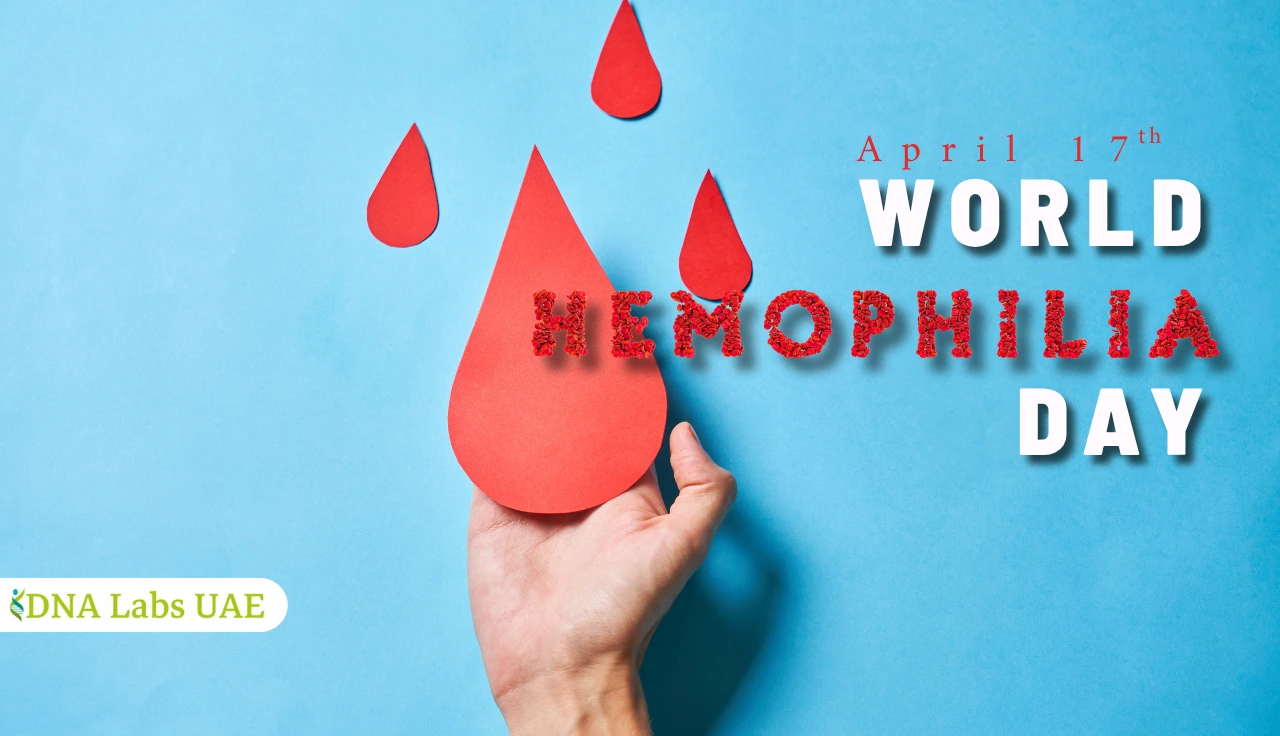
World Hemophilia Day 2026 reflects a seismic shift in hematology. The WFH has positioned “Diagnosis: First step to care” as the global north star — urging health systems to move past awareness into confirmed, evidence-based diagnosis. Despite medical progress, nearly 75% of individuals with bleeding disorders remain invisible to the formal healthcare system, creating a silent crisis in treatment equity. In the UAE, this gap is being closed with national precision medicine programs, rare disease registries, and molecular diagnostics at scale.
Diagnostic literacy: rewriting the family playbook
In the UAE, diagnostic literacy means families stop guessing and start knowing. It’s not just “a bleeding disorder” — it’s the precise mutation in F8 or F9, the inheritance pattern, the inhibitor risk. Our local lab data shows that families who pursue early molecular testing achieve faster treatment initiation, sharper bleeding management, and confident reproductive planning. Genotype-first care transforms hemophilia from reactive ER visits to predictive, personalized health journeys.
Evidence-based testing: the backbone of UAE precision medicine
Insurance approvals, government rare disease programs, and national genomic registries now rely on lab-verified data. The UAE’s investment in next-generation sequencing and inversion analysis for Hemophilia A sets a new benchmark for the region. Diagnostic certainty is no longer optional — it’s the gateway to targeted therapies and sustainable care models.
🔍 Where to get reliable molecular screening in the UAE?
Health-First Urbanism: diagnostics as everyday infrastructure
The UAE is pioneering Health-First Urbanism — where diagnostic hubs become community anchors. Labs are evolving into preventive screening centers, genetic counseling nodes, and precision medicine coordination points. No longer isolated services, molecular diagnostics are woven into the patient journey, ensuring early detection and lifelong care coordination. This urban-health fusion makes the UAE a living lab for rare disease ecosystems.
In modern systems like the UAE, awareness campaigns are no longer the goal — confirmed molecular diagnosis is the true measure of success. Enter “Diagnostic Sovereignty”: replacing symptom-based assumptions with genetic confirmation, building national genomic datasets, and ensuring every suspected bleeding disorder is mapped to a FVIII or FIX mutation. This is how precision hematology becomes the standard, not the exception.
From “suspected” to “genetically verified” — diagnostic sovereignty empowers clinicians, payers, and families.
Scientific milestones · UAE hematology 2026
Myth vs. Science: what you need to know
| Myth | Scientific evidence |
|---|---|
| Hemophilia is always inherited in every case | Up to 30% of cases arise from spontaneous mutations in Factor VIII or IX genes |
| Severity is identical across all patients | Severity varies based on specific genetic mutations and residual factor activity |
| Symptoms alone are enough for diagnosis | Definitive diagnosis requires molecular and coagulation factor testing |
| All treatments are the same | Therapy is individualized based on genetic subtype and inhibitor risk profile |
World Hemophilia Day 2026 marks a transformation from awareness-driven messaging to diagnosis-first precision medicine. In the UAE, this shift is reinforced by genomic investments, Health-First Urbanism, and a national commitment to rare disease excellence. The region is not just catching up — it’s building the diagnostic blueprint for the next decade.
📢 Molecular confirmation: the first step to care
UAE families now have direct access to world-class hemophilia genetic testing, coagulation profiling, and carrier screening — driving better outcomes, reproductive autonomy, and national health intelligence.